
How to Evaluate If Your Business Is Ready for AI Automation
A practical AI readiness assessment for business owners — the five dimensions that decide whether automation will pay off, a self-scoring scorecard, a step-by-step assessment process, and the green lights and red flags to check before you build.
How Do You Know If Your Business Is Ready for AI Automation?
Your business is ready for AI automation when you have a repetitive, rules-rich process, clean and accessible data, systems an agent can connect to, a team willing to change how it works, and a cost case that pays back inside a year. Readiness isn't about being big or technical — it's about having one well-shaped process where those five conditions line up. Most businesses are ready for something, just not everything at once.
The mistake we see most often isn't being too cautious — it's the opposite. A founder gets excited, picks the most visible, complicated workflow, and tries to automate it first. It fails, the team loses faith, and "AI" becomes a dirty word internally for the next two years. Readiness is the difference between a pilot that earns trust and one that burns it.
This post gives you the assessment we actually use with clients before recommending an automation project: the five dimensions of readiness, a self-scoring scorecard you can fill out in twenty minutes, a step-by-step way to run the assessment yourself, and the concrete green lights and red flags that tell you whether to proceed now or wait.
What Does "AI Readiness" Actually Mean?
AI readiness means your business has the specific conditions in place for an automation project to succeed: the right kind of work, the right data, the right systems, the right people, and the right economics. It is a property of a process, not of a company — you don't become "AI-ready" all at once, you become ready for one workflow at a time.
This framing matters because most "are we ready for AI?" conversations start in the wrong place. They start with the technology — which model, which platform, which vendor — when the technology is rarely the constraint anymore. Capable AI agents that plan steps, call APIs, and hand off to humans cleanly are within reach for any business in 2026. We covered what these agents actually are in AI Chatbot vs AI Agent and where they fit in How AI Agents Are Transforming Business Operations.
The real constraint is fit. An agent dropped onto a messy, low-volume, exception-heavy process with no data and a resistant team will fail no matter how good the model is. The same agent on a repetitive, data-rich, well-understood process will look like magic. Readiness is just the honest measurement of which situation you're in — before you spend money finding out.
The Five Dimensions of AI Automation Readiness
There are five dimensions to score: process, data, systems, team, and economics. A project succeeds when all five are reasonably strong; it stalls when even one is badly weak. Think of them as a chain — automation is only as ready as its weakest link, which is why scoring all five honestly beats over-investing in any single one.
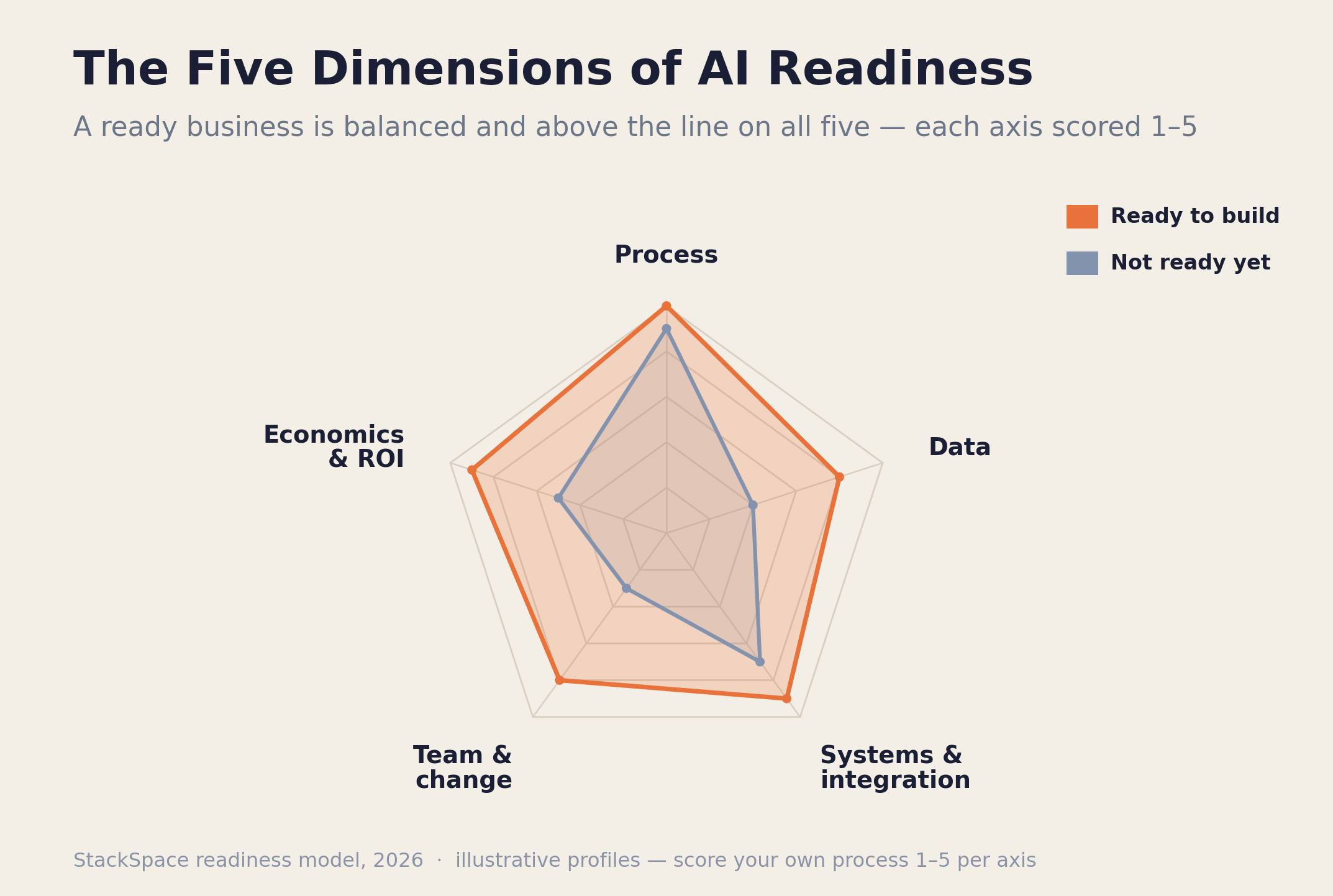
The chart above shows the pattern we see across real assessments. A business that's genuinely ready (the orange profile) doesn't max out every dimension — it's balanced and above the line on all five. A business that isn't ready yet (the slate profile) often scores high on one or two and has a glaring gap somewhere else: great data but a team that refuses to change, or an obvious process but data scattered across notebooks and someone's head. The gap is the thing to fix first.
The rest of this post walks through each dimension, what "ready" looks like, and the questions to ask yourself. Then we'll turn it into a score.
Dimension 1: Process Readiness — Is the Work Repetitive and Rules-Rich?
A process is ready when it's repetitive, high-volume, rules-based, and well-understood by the people who do it today. The best first candidates are tasks your team does dozens of times a week the same way — not the rare, judgment-heavy decisions. If you can't write down how the work is done, an agent can't learn it either.
Process is the first dimension because it's the one that most often disqualifies a project on its own. AI agents shine on work that is frequent and pattern-rich; they struggle on work that is rare, ambiguous, or genuinely novel each time. The sweet spot has three traits:
- Volume. The task happens often enough that automating it saves real hours. Automating something that happens twice a month rarely pays back.
- Repeatability. The steps are broadly the same each time, even if the inputs vary. Messy inputs are fine — agents handle those better than old rule-based RPA — but the goal and the shape of the work should be consistent.
- Documented logic. Someone can explain the decision rules, even informally. If the only person who understands the process is one veteran employee who "just knows," your first job is to capture that knowledge, not automate it.
The five processes we most often recommend as first projects — support triage, lead qualification, invoice processing, inventory monitoring, and internal helpdesk — all score high here. We broke down each one in 5 Business Processes You Can Automate with AI Agents Today.
Dimension 2: Data Readiness — Is Your Data Clean, Accessible, and Sufficient?
Data is ready when it's accessible through systems (not trapped in someone's inbox), reasonably clean, and there's enough history for the agent to learn the pattern. You don't need a data warehouse or perfect records. You need data that lives somewhere a system can reach, in a format that isn't actively misleading.
Data is where most readiness assessments quietly fail, because data problems are invisible until you try to use the data. Three questions cut to the truth:
- Where does the data live? If the information an agent needs is in a database, a CRM, a spreadsheet, or even structured emails, you're in good shape. If it lives in PDFs, handwritten notes, phone calls, or one person's memory, that's a gap to close first.
- Is it clean enough? Real-world data is never spotless — duplicates, missing fields, and inconsistent formats are normal. The question is whether it's consistent enough to act on. A 5% error rate is workable; a 40% error rate means the agent learns the wrong thing.
- Is there enough of it? An agent triaging support tickets needs a few months of resolved tickets to learn from. A handful of examples won't do. More history almost always beats clever modeling.
If your honest answer is "our data is a mess," that's not a reason to abandon automation — it's a reason to sequence it. Cleaning and centralizing data is often the highest-ROI first project, because everything else depends on it.
Dimension 3: Systems & Integration Readiness — Can AI Plug Into Your Stack?
Systems are ready when the tools an agent needs to read from and write to have APIs or integrations, and aren't a tangle of closed, legacy software. An agent creates value by taking action — updating a CRM, sending an email, flagging an order — and it can only do that if your systems let software in. Modern, API-first tools make this easy; closed legacy systems make it expensive.
This dimension is the most technical, but the principle is simple: an automation is only as connected as the systems around it. A few things to check:
- Do your core tools have APIs? Most modern SaaS — your CRM, helpdesk, accounting, e-commerce, and project tools — expose APIs an agent can use. This is usually the easy case.
- Are the critical systems closed or legacy? Old, on-premise, or heavily customized systems with no integration layer are the expensive case. The work isn't impossible, but the integration cost can dwarf the automation itself — a hidden cost we wrote about in Hidden Costs of Software Development.
- Is your stack consolidated or scattered? If the same customer record lives in five disconnected tools, the agent spends its effort reconciling systems instead of doing useful work. This is one reason API-first and headless architectures pay off — see What Is a Headless ERP?.
You don't need a perfect stack. You need the specific systems involved in your first automation to be reachable.
Dimension 4: Team & Change Readiness — Will People Actually Use It?
Your team is ready when leadership backs the project, the people whose work changes are involved early, and there's a plan for what they do with the time automation frees up. This is the dimension founders most underestimate. The best automation in the world delivers zero value if the team works around it, distrusts it, or quietly keeps doing the task by hand.
Automation is a change-management project wearing a technology costume. Two failure modes dominate, and both are about people, not code:
- Fear. If staff believe the automation exists to replace them, they'll undermine it — consciously or not. The honest framing that actually works: the agent handles the repetitive volume so people can do the higher-value work only humans can. That has to be true, and it has to be said out loud, early.
- No owner. A successful automation needs someone responsible for tuning it — reviewing its outputs, adjusting thresholds, catching drift. Projects with no internal owner degrade silently until someone notices the agent has been wrong for a month.
The practical test: can you name the person who will champion this internally, and the people whose daily work will change? If those people are in the room before the build starts, you're ready. If the plan is to surprise them with it at launch, you're not.
Dimension 5: Economic Readiness — Does the ROI Math Work?
The economics are ready when the time or money the automation saves clearly exceeds what it costs to build and run, with payback inside roughly a year. AI automation is an investment, not magic — it has a build cost, a monthly running cost (model usage, infrastructure, maintenance), and a real ROI you can estimate before committing a peso.
The math is more honest than most vendors make it sound. A workable estimate has four inputs:
| Input | What to estimate | Example |
|---|---|---|
| Hours saved per month | Time the process takes today × how much the agent handles | 80 hrs/mo × 70% = 56 hrs |
| Value of those hours | Loaded cost of the staff time freed up | 56 hrs × ₱500/hr = ₱28,000/mo |
| Build cost | One-time cost to design, build, and deploy | ₱250,000 – ₱600,000 |
| Running cost | Model usage + infrastructure + maintenance, monthly | ₱8,000 – ₱25,000/mo |
Plug in your own numbers. If monthly savings comfortably exceed monthly running costs and the build pays back within a year, the economics are ready. If the savings are thin or the process volume is low, the honest answer is "not yet" — and that's a far cheaper thing to learn now than after the build. For grounding on real build costs, see our Custom Software Cost in the Philippines guide.
The AI Automation Readiness Scorecard
Score your candidate process from 1 to 5 on each of the five dimensions, then add them up for a total out of 25. A total of 19–25 means proceed, 12–18 means run a small pilot first, and below 12 means fix the fundamentals before you build. Score the specific process you have in mind — not your company in general.
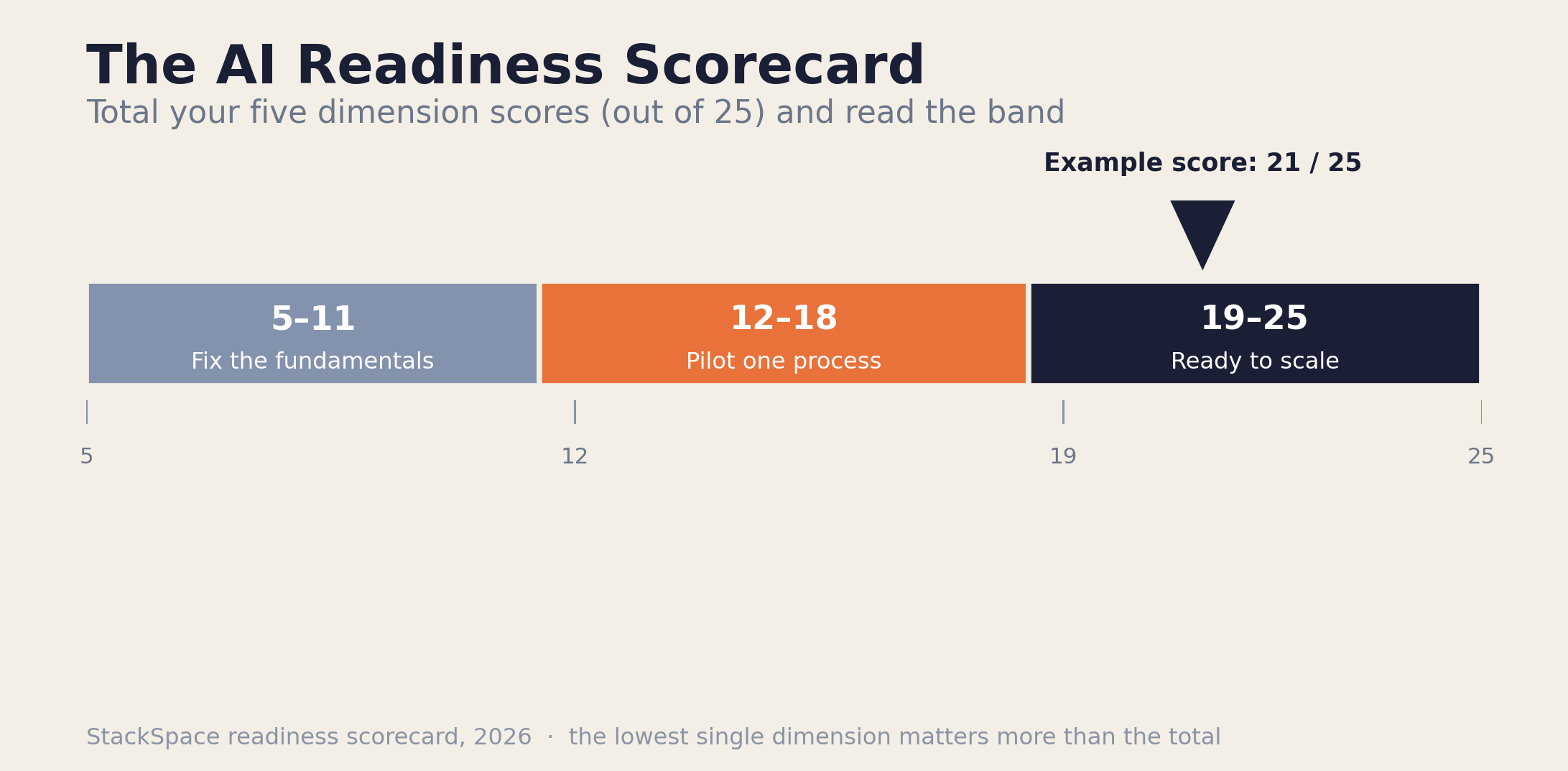
Use this rubric for each dimension. Be honest — inflating the score only moves the failure from the assessment (cheap) to the project (expensive).
| Dimension | Score 1 (weak) | Score 5 (strong) |
|---|---|---|
| Process | Rare, ad-hoc, undocumented | High-volume, repeatable, well-understood |
| Data | In heads, paper, or PDFs; messy | In systems, clean, plenty of history |
| Systems | Closed, legacy, disconnected | Modern, API-first, consolidated |
| Team | Resistant, no owner, surprise launch | Bought-in, named owner, involved early |
| Economics | Thin savings, unclear payback | Clear savings, payback under a year |
The reason for the three bands is that a low score doesn't mean "never." It means "not this, not yet." A 14 usually points to one fixable gap — clean the data, get the team involved, pick a higher-volume process — that moves you into the proceed zone within a quarter.
How to Run Your Own AI Readiness Assessment (Step by Step)
To run the assessment yourself: list your repetitive processes, pick the strongest candidate, score it on the five dimensions, identify the weakest link, and decide to proceed, pilot, or prepare. It takes an afternoon and saves you from the far more expensive version of this lesson — learning it mid-build.
Here's the process we walk clients through:
- List your repetitive processes. Write down every task your team does often and roughly the same way each time — support replies, data entry, follow-ups, reporting, reconciliation. Aim for ten to fifteen.
- Pick the single strongest candidate. Not the most painful or most visible — the one with the highest volume, clearest rules, and most accessible data. The first project's job is to earn trust, so it should be the one most likely to win.
- Score it on the five dimensions. Use the rubric above, 1–5 each, total out of 25. Pull in the person who actually does the work — they'll catch the data and process realities you can't see from the top.
- Find the weakest link. The lowest single score matters more than the total. A 4-4-4-4-1 averages well but will still fail on that 1. Name the gap explicitly.
- Decide: proceed, pilot, or prepare. Score 19+ with no 1s or 2s → proceed to a real build. Score 12–18 → run a narrow pilot on one channel to de-risk it. Below 12, or any dimension at 1 → fix that fundamental first.
This is the same disciplined, front-loaded approach we take to scoping any project — we wrote about why in How We Scope a Custom Software Project in 48 Hours. A sharp assessment up front is the cheapest insurance you can buy against a failed automation.
Green Lights and Red Flags: When to Proceed vs Wait
Proceed when you have a high-volume process, accessible data, an integration-friendly stack, a bought-in team, and clear ROI. Wait when the process is rare or undefined, the data is trapped or dirty, the systems are closed, the team is resistant, or the savings are thin. The signals below are the shorthand version of the full scorecard.
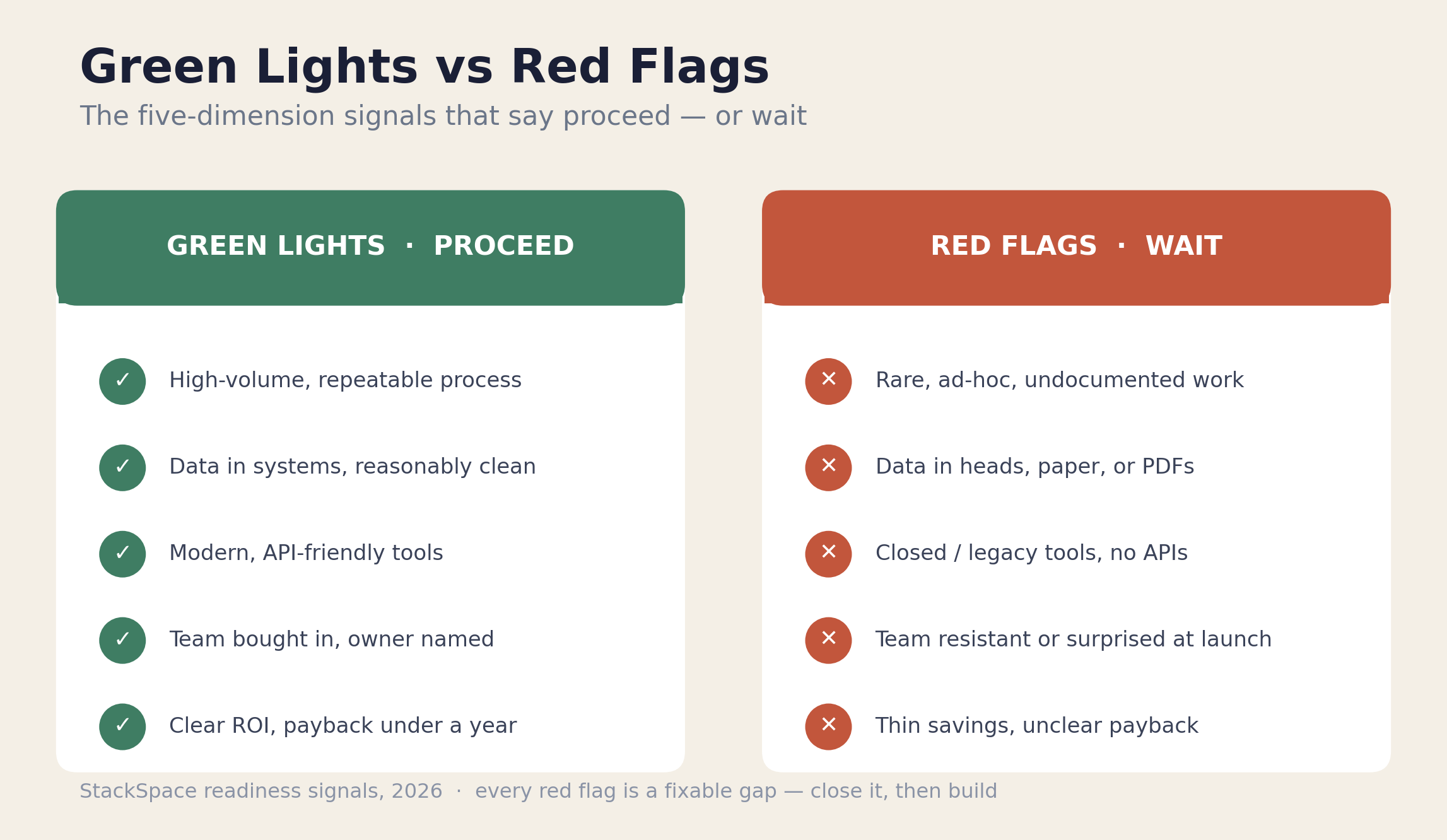
None of the red flags is permanent. Each one is a specific, fixable gap — and naming it is the first step to closing it. The point of the assessment isn't to gatekeep automation; it's to make sure the first project is the one that succeeds, because the first project decides whether there's a second one.
What to Do If You're Not Ready Yet
If you're not ready, the answer is almost never "give up on AI" — it's "fix the one thing in the way." The most common gaps are messy data, an undefined process, and a team that hasn't been brought along — and each has a cheaper first project that makes the real automation possible later.
- If the gap is data: make data centralization your first project. Getting your records into systems an agent can reach is valuable on its own and unlocks every future automation.
- If the gap is process: document the workflow before automating it. The act of writing down how the work is actually done often reveals it can be simplified or partly automated with no AI at all.
- If the gap is the team: start with a small, visible, low-risk automation that helps people rather than replacing anyone. One win that makes someone's day easier does more for adoption than any all-hands presentation.
- If the gap is economics: pick a higher-volume process, or wait until the volume grows. Automating a low-volume task rarely pays back no matter how clean the build.
"Not yet" is a legitimate, money-saving answer. A good partner will tell you when you're not ready instead of selling you a build that won't deliver — the same way we'd rather scope honestly than chase a project that won't succeed.
Frequently Asked Questions
How do I know if my business is ready for AI automation?
Score a specific process on five dimensions — process, data, systems, team, and economics — from 1 to 5 each. A total of 19 or more (with no scores of 1) means you're ready to build; 12 to 18 means run a small pilot first; below 12 means fix the weakest fundamental before investing. Readiness is about having one well-shaped process, not about company size.
Do I need clean data before automating with AI?
You need data that's accessible and consistent enough to act on, not perfect. A small error rate is normal and workable. But if the data an agent needs lives in PDFs, paper, phone calls, or one person's head, centralizing it should be your first project — every automation depends on the agent being able to reach the data through a system.
How much does AI automation cost for a small business?
A focused first automation typically runs ₱250,000–₱600,000 to build, plus a monthly running cost for model usage, infrastructure, and maintenance. The right way to judge it is ROI: if the staff hours it frees up are worth clearly more than the monthly running cost and the build pays back inside a year, the economics are ready.
What's the biggest reason AI automation projects fail?
Picking the wrong first process and ignoring the team. Founders often automate the most visible, complex workflow instead of the highest-volume, well-understood one — so it fails and erodes trust. The other killer is launching without involving the people whose work changes, who then work around the tool. Both are readiness failures, not technology failures.
Can I automate a process if my systems are old and don't have APIs?
Yes, but it costs more. Closed or legacy systems without integration points require building a connection layer, which can cost more than the automation itself. If your critical systems are locked down, factor that integration cost into the ROI math — or sequence a modernization step first. Modern, API-first tools make automation dramatically cheaper.
Should I build a custom AI automation or buy an off-the-shelf tool?
Buy when an off-the-shelf tool fits your process closely; build when your process is a core differentiator or no tool matches how you work. The readiness assessment applies either way — even an off-the-shelf tool fails on a messy process, dirty data, or a resistant team. The build-vs-buy logic mirrors what we cover in Off-the-Shelf ERP vs Custom-Built.
Key Takeaways
- Readiness is a property of a process, not a company. You don't become AI-ready all at once — you get ready for one well-shaped workflow at a time, and most businesses are ready for something today.
- Score five dimensions: process, data, systems, team, and economics. A project succeeds when all five are reasonably strong and fails when even one is badly weak — automation is only as ready as its weakest link.
- Use the scorecard: 19–25 proceed, 12–18 pilot first, below 12 fix the fundamentals. Score the specific process honestly; the lowest single score matters more than the total.
- Pick the first project to earn trust — highest volume, clearest rules, cleanest data — not the most painful or visible one. The first automation decides whether there's a second.
- The team is the dimension founders underestimate most. Involve the people whose work changes before the build, name an owner, and be honest that the goal is freeing up higher-value work.
- "Not ready yet" is a money-saving answer. Most gaps — messy data, an undefined process, a team not brought along — have a cheaper first project that makes the real automation possible later.
If you want a straight answer on whether your business is ready — and which process to start with — book a free consultation call. We'll run the assessment with you and tell you honestly whether to build now, pilot first, or fix the fundamentals — no project required.
Further reading: 5 Business Processes You Can Automate with AI Agents Today, AI Chatbot vs AI Agent: What's the Difference and Which Does Your Business Need?, and How AI Agents Are Transforming Business Operations.
Written by
Jabez Borja
More articles
Hidden Costs of Software Development Nobody Warns You About
The line items that don't show up in a software quote but blow up the budget anyway — maintenance, infrastructure, scope creep, integrations, and more. A 2026 breakdown with realistic ranges and a pre-signature checklist.
Our Tech Stack for Building Client Projects in 2026: Tools, Infra, and Why
A transparent look at the tech stack StackSpace uses to build client projects in 2026 — the frontend, backend, database, infrastructure, and AI tools we default to, the criteria we choose them on, and where we deliberately deviate.
What Is a Headless ERP? Why Growing Companies Are Switching in 2026
A plain-English guide to headless ERP in 2026 — what it is, how the architecture differs from traditional ERP, why growing companies are switching, what it costs, and when it's the wrong call.
Want to build something?
We help businesses turn ideas into production software. Book a discovery call and let's talk about your project.