
What Is a Headless ERP? Why Growing Companies Are Switching in 2026
A plain-English guide to headless ERP in 2026 — what it is, how the architecture differs from traditional ERP, why growing companies are switching, what it costs, and when it's the wrong call.
What Is a Headless ERP?
A headless ERP is an enterprise resource planning system whose back end — data, business logic, and workflows — is decoupled from its front end and exposed through APIs. Instead of one fixed interface, any number of apps, portals, websites, or devices consume the same ERP core over an API. "Headless" means the system ships without a built-in "head" (the UI).
If that sounds abstract, here's the practical version: in a traditional ERP, the screens your team uses are welded to the engine underneath. You change one, you risk the other. In a headless ERP, the engine runs on its own and you build — or buy — whatever screens you want on top of it. The same inventory, finance, and order data can power your warehouse tablet, your customer portal, your e-commerce checkout, and your finance dashboard at once, with no duplicated logic.
This is the same architectural shift that already reshaped content management (headless CMS) and commerce (headless commerce). It's now arriving in ERP, and for fast-growing companies the appeal is specific: change the experience without re-platforming the engine.
Headless ERP vs Traditional ERP: What Actually Changes
The core difference is coupling. A traditional ERP bundles the user interface, business logic, and database into one monolithic application; a headless ERP separates the back end from the front end and connects them through APIs. That single change — decoupling — is what unlocks everything else people associate with "modern" or "composable" ERP.
In a monolith, the UI and the engine share the same codebase and release cycle. A new field on a form, a new mobile workflow, or an integration with an outside tool means touching the core — slower changes, riskier upgrades, and a vendor's roadmap dictating your pace. In a headless model, the front end is just another API client. You can redesign a screen, launch a customer portal, or wire in a new sales channel without redeploying the ERP itself.
| Dimension | Traditional (Monolithic) ERP | Headless ERP |
|---|---|---|
| Architecture | UI, logic, and data fused in one app | Back end decoupled, exposed via APIs |
| User interface | One fixed, vendor-supplied UI | Any number of custom front ends |
| Integrations | Plugins, connectors, sometimes brittle | API-first, integration is the default |
| Omnichannel | Hard — each channel bolted on | Native — every channel hits one core |
| Changing the UX | Touches the core; risky upgrades | Front end ships independently |
| Upgrade path | Big-bang, often delayed for years | Incremental, layer by layer |
| Best fit | Stable processes, single primary UI | Multi-channel, fast-changing front ends |
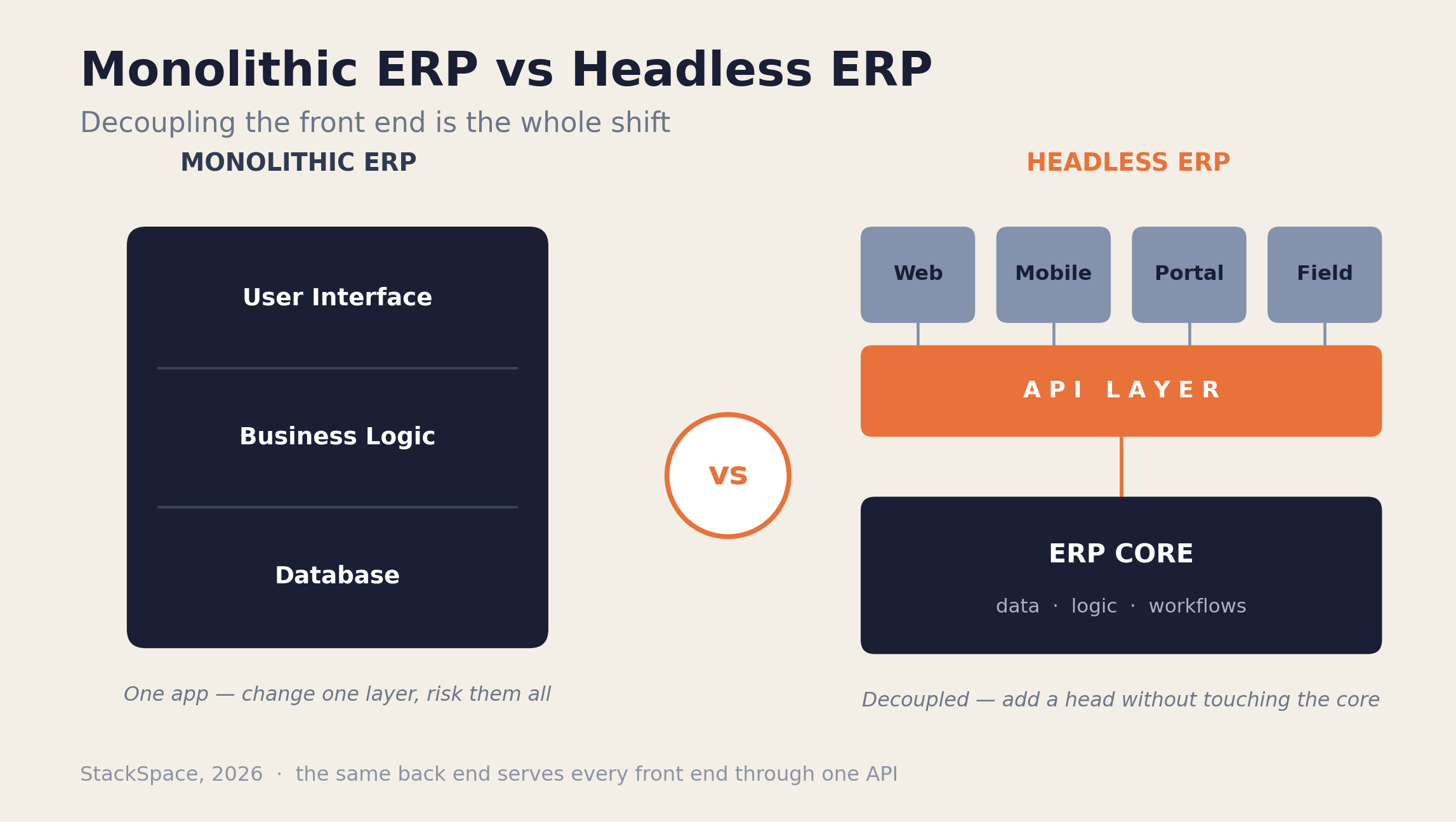
The row that matters most for a growing company is "changing the UX." In a monolith, every front-end change is a negotiation with the core and, often, with the vendor. In a headless setup, the team that owns the customer experience can move at its own speed — which is exactly the speed a scaling business needs.
How a Headless ERP Actually Works
A headless ERP works by splitting the system into three layers that talk over APIs: a data-and-logic core, an API layer that exposes it, and one or more independent front ends that consume it. Each layer can be built, deployed, and scaled on its own.
The ERP core
This is the engine: your master data (products, customers, suppliers), your transactional records (orders, invoices, inventory movements), and the business logic that enforces the rules — pricing, approvals, accounting, fulfillment. In a headless model the core has no screens of its own. Its job is to hold the truth and enforce it consistently, no matter which channel a request comes from.
The API layer
Every capability of the core is exposed through well-defined APIs — usually REST or GraphQL, increasingly with webhooks and event streams for real-time updates. This layer is the contract. Any client that speaks the API can read and write ERP data without knowing how the core is built internally. It's also where authentication, rate limiting, and permissions live, so a customer-facing app and an internal tool can safely share the same back end.
The front ends (the "heads")
These are the experiences your people and customers actually touch: a warehouse app on a rugged tablet, a finance dashboard, a self-service customer portal, an e-commerce storefront, a field-sales app, a partner API for a logistics provider. Each is a separate application that calls the API. Add a new channel and you add a new head — you don't re-architect the engine. We unpack the front-end side of this in Next.js vs React Native vs Flutter, since the "head" is usually one of those.
The same API-first thinking applies to the back end you build the core on. If you're greenfield, the choice of engine and data layer matters — we walk through that trade-off in Supabase vs Firebase vs Custom Backend.
Why Growing Companies Are Switching to Headless ERP
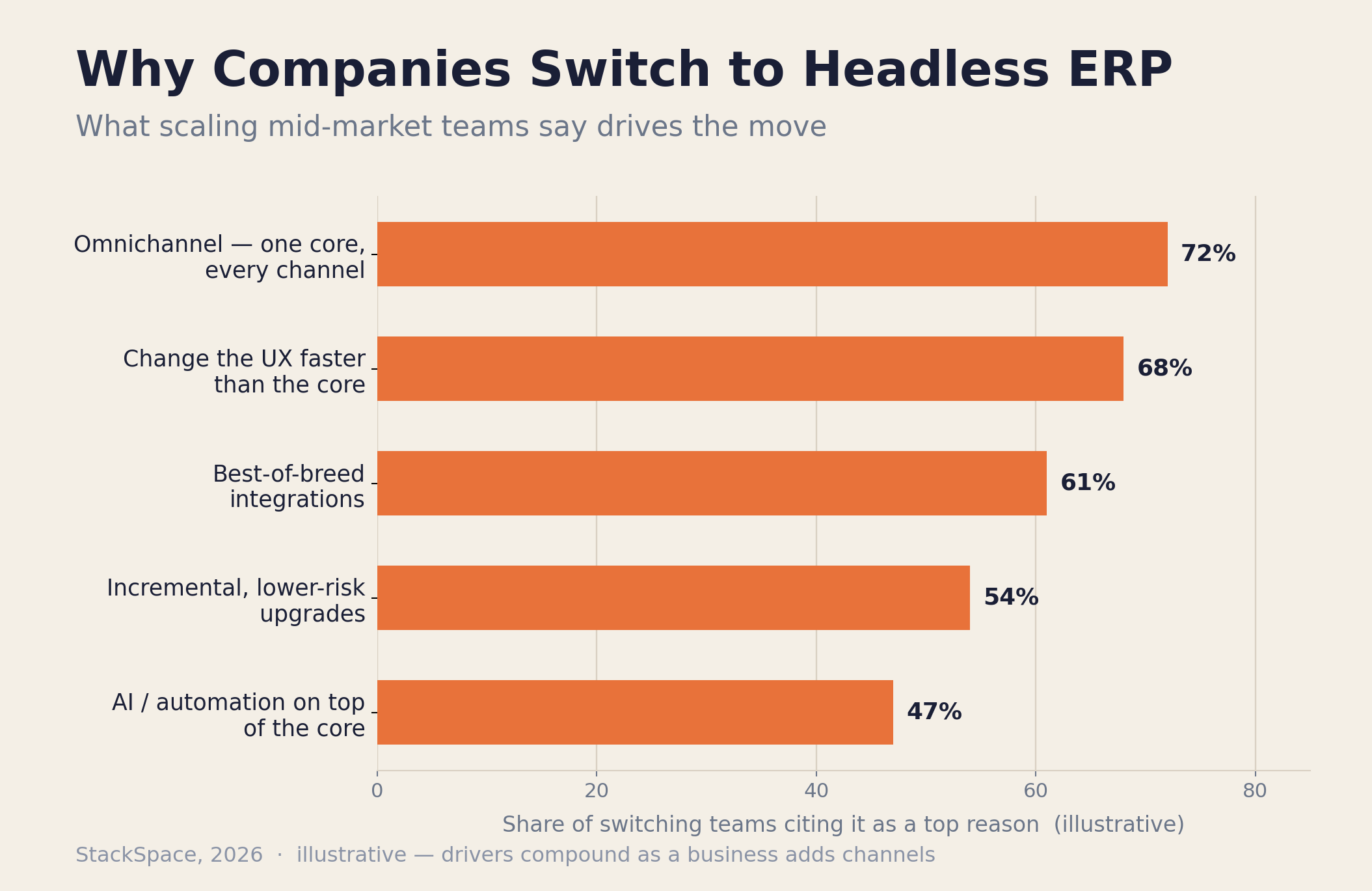
Growing companies switch because a monolithic ERP becomes the bottleneck exactly when they need to move fastest. The four drivers are omnichannel demands, the need to change customer experiences quickly, integration with best-of-breed tools, and an incremental upgrade path that avoids a risky big-bang replacement. Scale exposes the cost of coupling.
1. Omnichannel is no longer optional
A scaling business sells and operates across more surfaces every year — web, mobile, marketplaces, retail, field teams, partner APIs. In a monolith, each channel is a bolt-on with its own copy of logic and its own sync headaches. A headless core serves them all from one source of truth, so a price change or a stock update is correct everywhere at once.
2. The experience has to change faster than the engine
Customer expectations move quarterly; ERP cores are built to be stable for years. Headless lets those two clocks run independently. Your team can redesign a checkout, launch a returns portal, or ship a new sales app in weeks without touching — or risking — the system of record underneath.
3. Best-of-breed beats one-size-fits-all
Few companies want their ERP vendor's mediocre version of every tool. API-first architecture makes it natural to plug in the best CRM, the best warehouse system, the best analytics, the best AI layer — and swap any of them later. This is also where automation lives: an API-first core is far easier to wire into the kind of AI agents that automate business processes.
4. You can modernize without a big-bang rebuild
The scariest words in enterprise software are "rip and replace." Headless enables the opposite: strangle the monolith gradually. Put an API layer in front of the old system, peel off one capability or one front end at a time, and migrate on your schedule. The risk is spread across months of small releases instead of concentrated in one terrifying weekend.
What a Headless ERP Costs
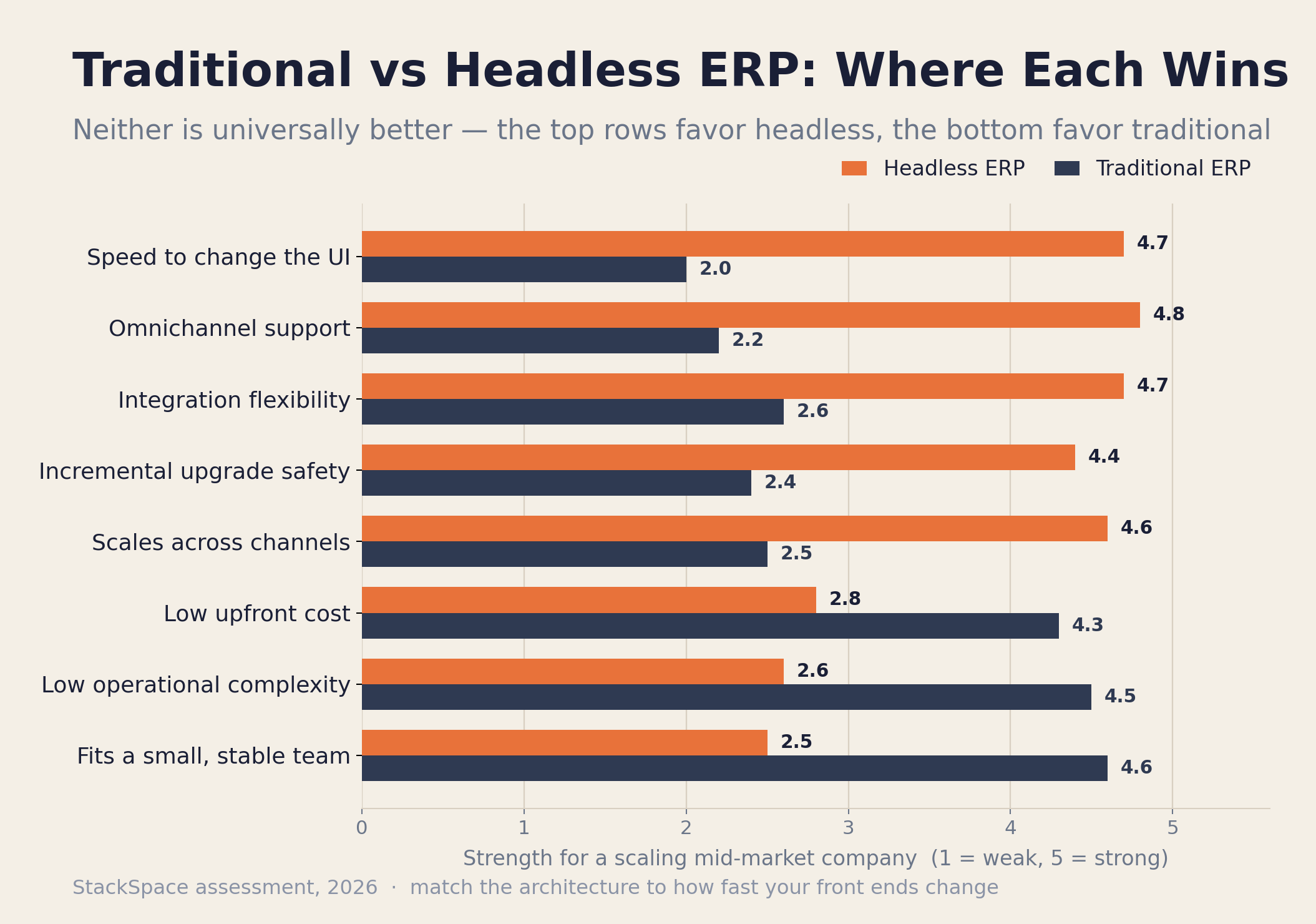
Headless ERP usually has a higher upfront build cost than buying a packaged ERP, but a lower cost of change over its lifetime. You pay more to decouple early; you pay less every time you add a channel, redesign a screen, or swap a tool — because none of those touch the core. The economics favor headless when you expect frequent change.
| Cost area | Traditional ERP | Headless ERP |
|---|---|---|
| Upfront build / setup | Lower — buy a packaged suite | Higher — design the API + front ends |
| Each new channel / UI | Expensive, often a project | Cheap — add another API client |
| Integrations | Connector fees, custom glue | Built-in, API-native |
| Major upgrades | Big, periodic, disruptive | Incremental, lower-risk |
| In-house skill needed | Configuration / admin | API + front-end engineering |
The honest trade-off is complexity and talent. A headless ERP is a distributed system: more moving parts, more services to monitor, and a real need for engineering capability you either hire or partner for. A 15-person company with stable processes and one main interface rarely needs it. A company adding channels every quarter, integrating constantly, and frustrated by how slowly its current system changes is usually already paying the cost of not being headless — in workarounds, duplicated data, and stalled projects. For how we'd think through the full build-versus-buy picture, see Off-the-Shelf ERP vs Custom-Built and The True Cost of Building a Custom Web Application.
When a Headless ERP Is the Right Call
A headless ERP is the right call when your front ends change far faster than your core, when you operate across multiple channels, and when integration is constant rather than occasional. It's the wrong call when your processes are stable, you have a single primary interface, and you lack the engineering capacity to run a distributed system. Match the architecture to how much your experience layer actually moves.
Headless is the right call when…
- You sell and operate across multiple channels (web, mobile, retail, marketplaces, field) that all need the same data.
- Your customer experience changes often and the current ERP can't keep up.
- You integrate constantly with best-of-breed tools and want to swap them freely.
- You want to modernize incrementally instead of betting the business on one cutover.
- You have engineering capacity in-house or through a partner.
Headless is overkill when…
- Your processes are stable and a packaged suite already fits them well.
- You have one main interface and no real omnichannel pressure.
- You're a smaller team without the appetite to operate a distributed system.
- You need to be live next month with the least possible moving parts.
If you're earlier in the journey and just deciding whether to buy or build at all, start with Off-the-Shelf ERP vs Custom-Built before worrying about headless — the architecture question comes after the buy-versus-build one.
How to Move Toward Headless ERP: A Practical Path
You don't have to go headless in one leap. The pragmatic route is to wrap your existing system in an API, peel off the highest-value front end first, and expand one capability at a time. This is the "strangler" pattern, and it's how most successful migrations actually happen.
Step 1: Find the friction
Identify where your current ERP hurts most — usually the channel or screen you can't change fast enough, or the integration that keeps breaking. That's your first candidate to pull out, because it has the clearest payoff.
Step 2: Put an API in front of the core
Expose the data and logic that first front end needs through a clean API layer, even if the old monolith is still doing the work behind it. The API becomes the contract everything new will build against.
Step 3: Build the first head
Ship one new front end — a portal, a mobile app, a redesigned workflow — against that API. Prove the model on something real and visible before expanding. This is exactly the kind of tightly-scoped first slice we map out in How We Scope a Custom Software Project in 48 Hours.
Step 4: Expand and migrate on your schedule
Peel off the next capability, then the next. Over time, more of the work moves into modern services behind the API and less lives in the monolith — until the old system is either retired or relegated to a single, well-bounded role. No big-bang weekend, no all-or-nothing risk.
Common Mistakes Teams Make
A few patterns turn a promising headless project into an expensive one. Most are about going headless for the wrong reason, or underestimating what it takes to run.
- Going headless for the buzzword. If your experience layer rarely changes and you have one UI, you're adding complexity for benefits you won't use. Architecture should follow need, not fashion.
- Underestimating the API design. The API is the product in a headless system. A sloppy, inconsistent API turns every new front end into a fight. Invest in the contract early.
- Ignoring the operational burden. More services mean more monitoring, more failure modes, and a real on-call reality. Budget for the platform work, not just the features.
- Trying to do it all at once. Big-bang headless rebuilds carry the same risk as the big-bang replacements they're meant to avoid. Strangle the monolith incrementally instead.
- Forgetting data consistency. One source of truth is the whole point. If channels start keeping their own copies of logic or data, you've rebuilt the mess you were escaping.
Frequently Asked Questions
What does "headless" mean in a headless ERP?
"Headless" means the ERP ships without a built-in user interface — the "head." The back end (data, logic, workflows) runs on its own and is exposed through APIs, and you attach whatever front ends you want on top. It's the same idea as a headless CMS or headless commerce, applied to enterprise operations.
How is a headless ERP different from a traditional ERP?
A traditional ERP fuses the interface, business logic, and database into one application, so changing the UI means touching the core. A headless ERP decouples the back end from the front end and connects them through APIs, so you can build or change any number of front ends without re-architecting the engine underneath.
Is a headless ERP the same as a composable or API-first ERP?
They're closely related and often used together. "API-first" describes how the system exposes itself (every capability available through APIs). "Composable" describes assembling your stack from best-of-breed pieces. "Headless" specifically means the front end is decoupled from the back end. A headless ERP is almost always API-first, and headless architecture is what makes a composable stack practical.
Does a headless ERP cost more than a traditional one?
Usually more upfront and less over its lifetime. You invest more to design the API and build front ends, but every subsequent change — a new channel, a redesigned screen, a swapped tool — is cheaper because it doesn't touch the core. Headless pays off when you expect frequent change; a stable, single-interface business may never recoup the upfront cost.
Do we need an in-house engineering team for a headless ERP?
You need engineering capability, in-house or through a partner. A headless ERP is a distributed system with an API layer and multiple front ends to build and operate. Companies without that capacity often start by partnering with a studio to stand up the architecture and the first front ends, then bring more in-house as they grow.
Can we move to a headless ERP without replacing our current system?
Yes — that's the recommended path. Put an API layer in front of your existing ERP, build new front ends against it, and migrate capabilities out of the monolith one at a time (the "strangler" pattern). It spreads the risk across many small releases instead of one big cutover, and you can stop or adjust at any point.
Is a headless ERP overkill for a small business?
Often, yes. If your processes are stable, you have one main interface, and you don't face omnichannel pressure, a packaged ERP will serve you better and faster. Headless earns its complexity when your front ends change quickly, you operate across channels, and you integrate constantly — typically as a company scales.
Key Takeaways
- Headless ERP decouples the back end from the front end. The data-and-logic core is exposed through APIs, and any number of front ends consume it. "Headless" means no built-in UI.
- Decoupling is the whole point. It lets your experience layer change at its own speed without risking the system of record — the bottleneck that hurts growing companies most.
- Companies switch for four reasons: omnichannel, faster UX changes, best-of-breed integration, and an incremental upgrade path instead of a big-bang rebuild.
- The trade-off is complexity and talent. Higher upfront cost and a distributed system to run, in exchange for a much lower cost of change over time.
- Go headless when your front ends move faster than your core — and skip it when your processes are stable and you have a single primary interface.
- You can migrate incrementally. Wrap the old system in an API, peel off one front end at a time, and strangle the monolith on your schedule.
If you're weighing whether a headless architecture fits your operations — or whether a packaged ERP would serve you better — book a free consultation call. We've built and integrated operations platforms across distribution, retail, and field operations, and we'll tell you honestly when headless is the right shape for your business and when it's complexity you don't need yet.
Further reading: Off-the-Shelf ERP vs Custom-Built: Which Is Right for Your Business?, Supabase vs Firebase vs Custom Backend, and How We Scope a Custom Software Project in 48 Hours.
Written by
Jabez Borja
More articles
How to Evaluate If Your Business Is Ready for AI Automation
A practical AI readiness assessment for business owners — the five dimensions that decide whether automation will pay off, a self-scoring scorecard, a step-by-step assessment process, and the green lights and red flags to check before you build.
Hidden Costs of Software Development Nobody Warns You About
The line items that don't show up in a software quote but blow up the budget anyway — maintenance, infrastructure, scope creep, integrations, and more. A 2026 breakdown with realistic ranges and a pre-signature checklist.
Our Tech Stack for Building Client Projects in 2026: Tools, Infra, and Why
A transparent look at the tech stack StackSpace uses to build client projects in 2026 — the frontend, backend, database, infrastructure, and AI tools we default to, the criteria we choose them on, and where we deliberately deviate.
Want to build something?
We help businesses turn ideas into production software. Book a discovery call and let's talk about your project.