
Off-the-Shelf ERP vs Custom-Built: Which Is Right for Your Business?
A 2026 decision framework for ERP — with real pricing on SAP, NetSuite, Microsoft Dynamics, and Odoo, the true cost of customization, and a clear test for when to buy versus build.

Should You Buy an Off-the-Shelf ERP or Build a Custom One?
Buy an off-the-shelf ERP if your processes are standard, your industry has a mature vertical solution, and your team can adapt to the software. Build a custom ERP if your competitive advantage lives inside your operational workflow, you've outgrown three or more disconnected tools, or you've already paid to customize a packaged ERP twice. The wrong choice is expensive in both directions — a force-fit packaged ERP costs you in lost productivity and broken upgrades, while a half-considered custom build costs you in scope creep and missed go-lives.
This guide gives you the 2026 numbers, a five-step decision framework, and the failure modes we see most often when companies pick the wrong path.
The 2026 ERP Market in One Picture
Before the framework, the lay of the land. The global ERP software market is on track to hit roughly $83 billion in 2026 (Grand View Research) to $106 billion (Fortune Business Insights), depending on whose scope you trust. The vendors most companies actually evaluate cluster into three camps.
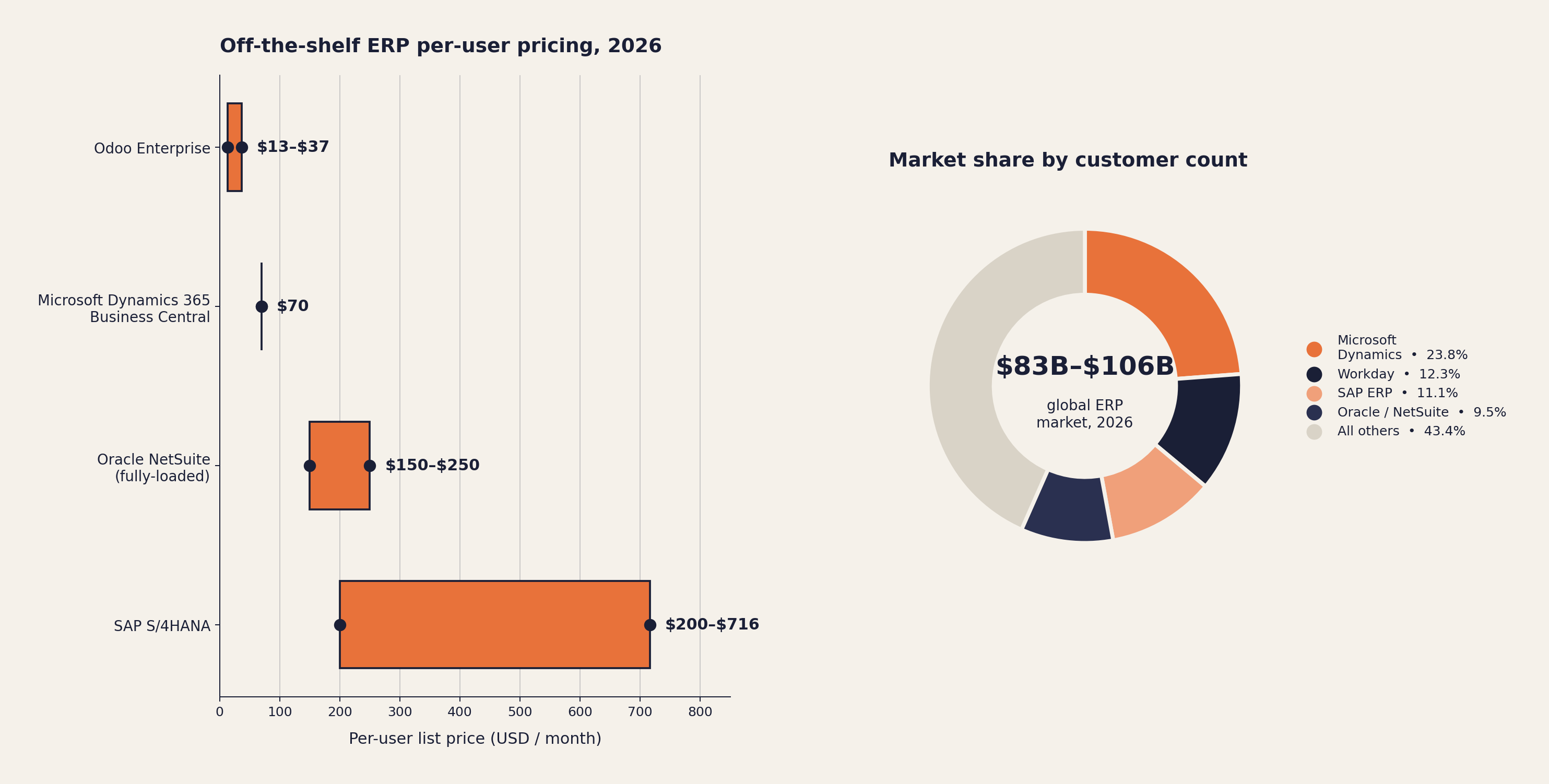
By 2024-2025 revenue, Oracle leads at ~$8.7B in ERP revenue with NetSuite + Fusion Cloud, SAP follows at ~$8.6B with S/4HANA, and Microsoft sits at ~$5.4B with Dynamics 365. By customer count, the order flips — Microsoft Dynamics has the largest deployed footprint at roughly 62,000 customers, followed by Workday at 32,000 and SAP at 29,000. That gap between revenue and customer count tells you everything: SAP and Oracle dominate the upper enterprise; Microsoft and Workday dominate the mid-market; and a long tail of vertical and open-source ERPs (Odoo, Acumatica, Epicor, Infor) serves the rest.
The numbers most ERP shoppers don't see until the proposal arrives:
- SAP S/4HANA: $200–$716 per user per month, typical mid-market deployments cluster around $350/user/month for Private Cloud.
- Oracle NetSuite: $99 baseline per user, but fully-loaded with platform fees and premium modules effective cost lands at $150–$250 per user per month.
- Microsoft Dynamics 365 Business Central: ~$70 per user per month — the best value if you're already a Microsoft shop.
- Odoo Enterprise: $13–$37 per user per month depending on plan, with regional pricing for the Philippines and Southeast Asia at the lower end.
Per-user license fees are only the visible cost. They typically account for 20–30% of total ERP spend over a five-year horizon. The other 70–80% is implementation, data migration, training, internal staff time, and the customizations you swore you wouldn't need.
What Off-the-Shelf ERP Actually Means in 2026
An off-the-shelf ERP (also called packaged or commercial ERP) is a pre-built enterprise resource planning system you license from a vendor — SAP, Oracle, Microsoft, NetSuite, Odoo, Acumatica, Sage, Infor, and others. You configure modules, map your processes onto the vendor's data model, and operate within the constraints of the platform. Most modern packaged ERPs are cloud-delivered (SaaS), with a smaller share running on-premise or in private cloud.
The pitch: faster time to value, lower initial cost, vendor-managed upgrades, a community of consultants and integrators, and pre-built modules for finance, inventory, procurement, HR, CRM, and manufacturing. The reality in 2026 is more nuanced. Cloud ERPs ship updates every quarter, which means customizations made to fit non-standard processes can break with vendor releases — and that breakage is one of the most consistent hidden costs we see in client audits.
A custom-built ERP, by contrast, is a system designed around your specific workflows from the ground up. You own the codebase, the data model is shaped by how your business actually operates, and there's no recurring per-user license fee. The cost is everything you'd outsource to a vendor in a packaged ERP — engineering, infrastructure, security, ongoing maintenance — now sits with your team or your build partner.
Direct Comparison: Off-the-Shelf vs Custom ERP
Here's how the two approaches stack up on the dimensions that actually drive a build-vs-buy decision.
| Dimension | Off-the-Shelf ERP | Custom-Built ERP |
|---|---|---|
| Time to first go-live | 3–9 months (SMB), 6–18 months (mid-market), 12–24 months (enterprise) | 4–9 months for a focused MVP; 9–18 months for a full multi-module platform |
| Year-1 cost (50 users) | $80K–$450K all-in | $60K–$300K depending on scope and team rates |
| 5-year TCO (50 users) | $400K–$1.8M | $200K–$900K including ongoing maintenance |
| Per-user fees | $13–$716 per user per month, recurring | None — infrastructure cost only ($200–$2,000/month total) |
| Process fit | Adapt your business to the software | Software shaped to your workflow |
| Customization risk | High — customizations break on vendor updates | Low — you control the upgrade cadence |
| Data ownership | Vendor-hosted, exit clauses vary | Full ownership, your infrastructure |
| Integration with existing tools | Pre-built connectors for popular tools; complex for niche | Built around your integration map from day one |
| Vendor lock-in | High — migration off costs $50K–$500K | None — codebase is yours |
| Ongoing support model | Vendor SLAs + implementation partner | Internal team or build partner retainer |
| Best for | Standard processes, single industry, lean ops team | Differentiated workflows, multi-entity, ops-as-product |
The takeaway: this isn't a simple "one is better" comparison. It's a question of where your operational complexity lives. Standard processes? Buy. Differentiated workflows that are part of how you compete? Build, or accept that you'll spend the same money on customization anyway.
The Hidden Costs Nobody Tells You About
Both paths carry hidden costs that don't show up in the headline pricing. Here's what we see consistently in client audits.
Hidden Costs of Off-the-Shelf ERP
Implementation fees dwarf the license. Panorama Consulting's 2025 benchmark study puts the average ERP implementation at $450,000, often exceeding the first three years of license fees combined. SAP S/4HANA implementations typically run $200K–$1M for mid-market deployments. NetSuite implementations average $50K–$250K depending on module count.
Customizations that break on upgrades. Cloud ERPs push updates every quarter. A manufacturing client we audited had accumulated 200+ customizations on an open ERP over four years. When they tried to upgrade, 80% of those customizations needed to be redone — at an estimated $200,000. They stayed on the old version, accruing growing security and compatibility debt.
Internal staff time during implementation. A 12–18 month mid-market ERP rollout pulls operations, finance, IT, and department leads into requirements workshops, data cleanup, user acceptance testing, and change management. Internal staff time routinely amounts to $150K–$400K in diverted salary cost — and it never appears in the vendor's proposal.
Integration breakage. When ERPs update, field names change, data types shift, and API endpoints get deprecated. Roughly 67% of Salesforce-ERP integrations fail in their first year by some industry surveys, and the fix cycle takes days of investigation each time because nobody documented which fields the integration actually used.
Per-user creep. Your headcount grows. Your per-user license fee grows linearly with it. A 50-person team paying $150/user/month for NetSuite owes $90K/year. At 200 people that's $360K/year — every year, forever, even after the system is fully paid for in your head.
Hidden Costs of Custom ERP
Scope creep during the build. The most common failure mode for custom ERP isn't a bad codebase — it's a moving target. Without a disciplined scoping phase, "one more module" extends the timeline by months. A solid build partner manages this with fixed scopes per phase and a clear change-order process.
Underestimated maintenance. Custom ERPs need ongoing engineering — security patches, framework upgrades, new feature work, bug fixes. Budget 15–25% of your initial build cost annually for maintenance and evolution. A $200K build needs $30K–$50K/year in steady-state engineering, not zero.
Operational dependency on a small team. A custom ERP maintained by one or two engineers is a single point of failure. Document the architecture. Use mainstream frameworks. Don't over-engineer for cleverness — every "elegant" abstraction is a maintenance burden for the next person.
Hosting and infrastructure. A custom ERP serving 50 users typically runs $200–$2,000/month in cloud infrastructure depending on database size, traffic patterns, and redundancy requirements. That's a fraction of a NetSuite license, but it's not free.
The honest math: off-the-shelf saves you up-front engineering investment but compounds over time as license fees and customization costs accumulate. Custom saves you ongoing fees but front-loads engineering risk.
Why Most ERP Projects Fail (And It's Not the Tech)
If there's one statistic to anchor an ERP decision around, it's this: Gartner's research finds 55–75% of ERP projects fail to meet their stated objectives, and Gartner projects that by 2027, more than 70% of recently implemented ERP initiatives will fail to fully meet their original business case goals — with up to 25% failing catastrophically.
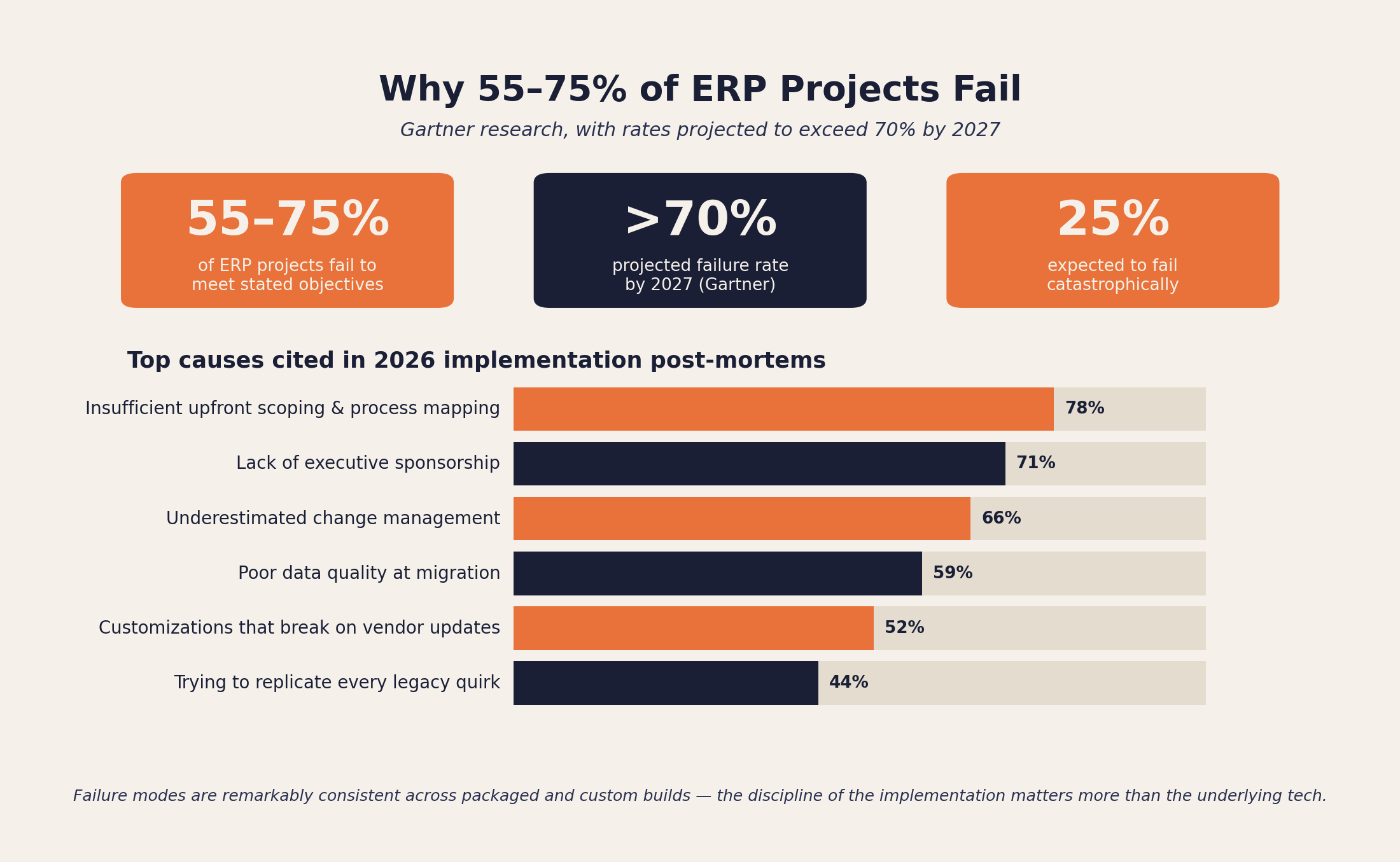
The failure modes are remarkably consistent across packaged and custom builds:
- Insufficient upfront scoping. Teams skip process mapping and discover misalignment in month six.
- Lack of executive sponsorship. ERP changes how every department works. Without a sponsor with real authority, change management collapses.
- Underestimated change management. Software is the easy part. Getting 200 people to actually use it consistently is the hard part.
- Poor data quality at migration. Garbage in, garbage out — and the cleanup work is always 2–3x what teams budget.
- Trying to replicate every legacy quirk. Some legacy behaviors exist because the old system couldn't do better. Re-implementing them in the new system perpetuates the dysfunction.
The implication for your build-vs-buy decision: don't pick based on the technology alone. Pick based on which path your team can actually execute. A modest, well-scoped Odoo deployment that ships on time beats a flagship S/4HANA project that drags into year three.
How to Decide: A 5-Step Framework
This is the framework we use at StackSpace when scoping ERP work for clients. Walk through it before talking to any vendor or build partner.
Step 1: Map Your Operational Complexity
Sketch your end-to-end operational workflow on a single page — order to cash, procure to pay, inventory to fulfillment, whatever the dominant flows are for your business.
For each major step, mark it as:
- Standard — your process matches industry best practice and could be picked up by a new hire with sector experience.
- Differentiated — your process is meaningfully different and that difference is part of how you compete or serve customers.
- Unique — your process can't be described with any standard ERP vocabulary because the business model itself is non-standard.
Count the marks. If 80%+ of your steps are standard, off-the-shelf wins. If 30%+ are differentiated or unique, you're either going to heavily customize a packaged ERP (expensive and fragile) or you should consider custom — and a custom build will fit your operations cleanly without the friction.
Step 2: Audit What You're Already Paying
List every operational tool your team uses today: accounting, inventory, CRM, fulfillment, HR, project management, reporting. Note the monthly cost, the user count, and whether the tools talk to each other.
If you're paying $5K–$15K per month across three or more disconnected tools that don't share data cleanly, you're already paying ERP money — you just don't have an ERP. The math for custom often becomes attractive at this point because consolidating onto a unified system pays for itself in 18–30 months.
If you're paying less than $3K per month total, an off-the-shelf SMB ERP (Odoo, Zoho, NetSuite SuiteSuccess) will almost certainly beat custom on TCO.
Step 3: Estimate 5-Year Total Cost of Ownership for Both Paths
Don't compare year-one costs — compare 5-year TCO. The ranking flips dramatically for many businesses.
Off-the-shelf 5-year TCO formula (rough order of magnitude):
- License fees: monthly per-user × users × 60 months
- Implementation: $50K–$500K depending on system and complexity
- Customizations: 10–30% on top of license fees over five years
- Integrations: $20K–$200K depending on tool sprawl
- Internal staff time during implementation: $150K–$400K
- Ongoing admin/consultant fees: $20K–$80K/year
Custom 5-year TCO formula:
- Initial build: $60K–$300K depending on scope
- Annual maintenance and feature work: 15–25% of build cost
- Hosting and infrastructure: $2K–$25K/year
- Internal product owner time: $40K–$80K/year of allocated headcount
For most mid-market companies (50–200 users) with at least moderately differentiated workflows, custom 5-year TCO lands at 40–60% of comparable packaged ERP TCO. For commodity processes at small scale, off-the-shelf wins clearly.
Step 4: Stress-Test the "Adapt Your Business" Assumption
Off-the-shelf ERPs work when your team adapts to the software. Custom ERPs work when the software adapts to your team.
Ask honestly: how much process change can your operations team absorb in the next 12 months? New software inevitably means new procedures, new approval flows, and new naming conventions. A team already drowning in operational change shouldn't take on a major packaged ERP rollout. A team that's stable and bored with manual workarounds is exactly the right time to either implement packaged ERP or commission a custom build.
Step 5: Pick Your Failure Mode
Every ERP project carries risk. The right question isn't "which approach is risk-free" — none are — it's "which failure mode can my company survive."
- Off-the-shelf failure mode: implementation drags 6 months past go-live, customizations fight vendor updates, internal team builds shadow workflows in spreadsheets. Cost: hundreds of thousands in sunk fees, possibly seven figures.
- Custom failure mode: scope creep extends the build, the system feels half-built at year one, you accumulate technical debt because you're rushing to ship. Cost: hundreds of thousands in build investment, potential rebuild in year three.
The off-the-shelf failure usually leaves you with software you can't escape because you've configured your business around it. The custom failure usually leaves you with code you can refactor or replace incrementally because you own it. Pick the failure mode you can recover from.
When Off-the-Shelf ERP Is the Right Call
Default to off-the-shelf if any of these are true:
- You're an SMB (under 50 users) with standard processes. The implementation overhead of custom isn't worth it. Pick Odoo, Zoho One, or NetSuite SuiteSuccess.
- You're in a regulated industry with mature vertical ERPs. Healthcare, pharma, defense, food and beverage all have battle-tested vertical packages — fighting them with custom is rarely worth the regulatory risk.
- Your finance team needs audit-grade accounting from day one. Building GAAP/IFRS-compliant accounting from scratch is a multi-quarter engineering investment. Buy it.
- Your team has zero ERP product management capacity. Custom requires a dedicated product owner. If you don't have one, you'll get a half-finished tool.
- You're planning to acquire or be acquired in the next 24 months. Custom systems complicate due diligence and integration. Stick with a recognizable platform.
For SMBs in the Philippines and Southeast Asia, Odoo Enterprise at $13–$24 per user per month is the most common starting point we recommend. Acumatica and Microsoft Dynamics 365 Business Central work well for companies with 50–200 users and a Microsoft-heavy stack.
When Custom ERP Is the Right Call
Build custom if any of these are true:
- You've already paid to customize a packaged ERP twice and the customizations broke on the last upgrade. You're already paying custom-ERP-level fees. Get the asset that comes with it.
- You're running operations across three or more disconnected SaaS tools and the integration tax is eating your team's time.
- Your operational workflow is part of how you compete. A logistics company with proprietary route optimization, a manufacturer with non-standard production sequencing, a distributor with unusual pricing logic — these don't fit packaged ERP cleanly.
- You're at 200+ users and per-user fees are becoming a meaningful line item. At scale, license fees compound aggressively. A custom ERP with ~$400/month infrastructure starts looking very attractive against $100K/year in NetSuite seats.
- You have multiple legal entities, multi-currency operations, and unusual consolidation requirements that the off-the-shelf options handle awkwardly.
Custom ERP work doesn't have to be a moonshot. A focused first-phase MVP — say, inventory and order management for a distribution business — can ship in 4–6 months for $60K–$150K when scoped tightly. Subsequent modules (finance, HR, CRM) get added in quarterly phases. This is roughly the model behind StackCore — our headless ERP product — which gives clients pre-built backend modules paired with a custom UI shaped to their team. For a deeper look at the economics of custom builds in the Philippine market, see our custom software cost guide.
The Hybrid Path: When Both Make Sense
A growing share of mid-market companies in 2026 are running hybrid setups: off-the-shelf for commodity functions, custom for differentiating workflows.
A typical hybrid stack:
- Accounting and finance: NetSuite, QuickBooks, or Xero (audit-grade, regulated, commoditized)
- CRM: HubSpot or Salesforce (mature, integration-rich)
- Custom operations layer: bespoke inventory, fulfillment, field ops, or production scheduling app that fits the business exactly
The custom layer reads from and writes to the off-the-shelf systems via API. You get audit-grade financials without rebuilding accounting from scratch, and you get operational flexibility without fighting an ERP's data model. This is also our most common engagement pattern — most clients we work with on custom system development are building the operations layer of a hybrid stack rather than replacing their entire ERP.
The hybrid path's tradeoff: more integration work, more vendors to manage, and stronger DevOps requirements. It's not the simplest setup, but for companies with $5M–$100M in revenue and meaningfully differentiated operations, it's often the most defensible long-term choice.
Common Mistakes Teams Make
After auditing dozens of ERP projects across different industries, the same wrong moves keep appearing.
Customizing a packaged ERP into something it wasn't designed to be. When you've paid for ten significant customizations on top of SAP or NetSuite, you've effectively built a custom ERP — but with all the constraints of the underlying platform and a recurring license fee. Either commit to the platform and fit your processes to it, or commission a custom build. Don't half-build both.
Choosing on year-one cost. ERP is a 5–10 year decision. Year-one cost is the most misleading data point in the entire evaluation. Always model 5-year TCO before signing.
Skipping the data migration scope. Data migration is consistently underestimated by 2–3x. Allocate 12–25% of your total ERP budget to data cleanup, mapping, and migration testing. If your legacy data is messy (and it is), this is the work that determines whether the new system actually works.
Underestimating change management. ERP rollouts fail at the people layer more often than the technology layer. Budget for training, internal champions, and a 60–90 day shadow operations period where the old and new systems run in parallel.
Picking the vendor before defining the requirements. Vendor demos are designed to make any business look like a perfect fit. Define your must-haves and nice-to-haves before sitting through demos, and stress-test each demo against your actual top 5 workflows — not the vendor's pre-built scenarios.
Frequently Asked Questions
Is custom ERP cheaper than off-the-shelf in 2026?
It depends on scale and complexity. For SMBs under 50 users with standard processes, off-the-shelf ERPs like Odoo or NetSuite SuiteSuccess are almost always cheaper on 5-year TCO. For mid-market companies (50–200 users) with differentiated workflows, custom ERP often lands at 40–60% of packaged ERP 5-year TCO — typically $200K–$900K versus $400K–$1.8M for an equivalent packaged deployment. Per-user license fees compound aggressively at scale, while a custom system has flat infrastructure costs.
How long does an ERP implementation take in 2026?
For SMBs deploying packaged cloud ERP with minimal customization, typical timelines are 3–6 months. Mid-market deployments run 4–9 months. Enterprise-grade rollouts with multiple legal entities or significant data migration typically take 12–24 months. Custom ERP MVPs ship in 4–9 months for a focused first-phase scope, with full multi-module platforms taking 9–18 months. The timeline driver in both cases is data migration and change management, not the underlying software.
What percentage of ERP projects fail?
According to Gartner, 55–75% of ERP projects fail to meet their stated objectives, with the failure rate projected to climb past 70% by 2027 — and up to 25% of those failing catastrophically. The most common causes are insufficient upfront scoping, lack of executive sponsorship, underestimated change management, and poor data quality at migration. The choice between packaged and custom doesn't change the failure rate much; how disciplined the implementation team is changes it dramatically.
How much does SAP S/4HANA cost per user in 2026?
SAP S/4HANA per-user pricing in 2026 ranges from $200/user/month (Cloud Essentials) to $716/user/month (high-end private cloud), with mid-market deployments most commonly landing around $350/user/month for Private Cloud Edition. Implementation typically adds $200,000 to $1 million depending on complexity. SAP S/4HANA is generally a fit for companies above ~$100M in revenue with regulated, multi-entity operations.
Can a custom ERP integrate with QuickBooks or Salesforce?
Yes — and this is a common architecture in 2026. The hybrid pattern uses off-the-shelf tools for commoditized functions (QuickBooks or Xero for accounting, Salesforce or HubSpot for CRM) and a custom application for differentiated operational workflows. The custom layer integrates via REST or GraphQL APIs and webhooks. This gives you audit-grade financials without rebuilding accounting and operational flexibility without fighting a packaged ERP's data model.
What's the cheapest off-the-shelf ERP for a small business?
Odoo Community is genuinely free if you self-host and implement internally, though most small businesses end up on Odoo Enterprise at $13–$24 per user per month for the platform plus $1,000–$15,000 for initial implementation. Zoho One, NetSuite SuiteSuccess, and Microsoft Dynamics 365 Business Central are competitive alternatives in the SMB segment, with Business Central at roughly $70/user/month being the strongest fit for Microsoft-heavy stacks.
When should I switch from QuickBooks (or similar) to an ERP?
Consider an ERP transition when you hit at least three of these signals: revenue above $5M annually, 50+ employees, three or more disconnected SaaS tools, monthly close taking more than five business days, or inventory across multiple locations or warehouses. Below those thresholds, QuickBooks plus a few well-chosen point tools usually outperforms a full ERP on TCO and team friction. Above them, the hidden cost of fragmented tools usually exceeds an ERP rollout.
Final Thoughts
There's no universally correct answer to off-the-shelf versus custom ERP — but there is a correct answer for your specific business, scale, and operational complexity. The right ERP is the one your team will actually use, that scales with your headcount without compounding fees, and that doesn't break every time the vendor (or your business) changes.
The decision usually breaks like this in 2026:
- SMB with standard processes → off-the-shelf SMB ERP (Odoo, Zoho One, NetSuite SuiteSuccess).
- Mid-market with mostly standard processes → off-the-shelf mid-market ERP (Microsoft Dynamics 365 Business Central, Acumatica, NetSuite).
- Mid-market with meaningfully differentiated workflows → hybrid stack: off-the-shelf for accounting and CRM, custom for the operations layer.
- Enterprise with regulated, multi-entity operations → off-the-shelf enterprise ERP (SAP S/4HANA, Oracle Fusion Cloud) with disciplined customization governance.
- Operationally differentiated business at any size → custom ERP shaped to your workflows, ideally on a platform like StackCore that gives you a head start on the commodity backend.
If you're in the middle of this decision and want a straight conversation about what fits your business — without a vendor pitch — start a project with us. We've built and audited ERPs across distribution, manufacturing, services, and field operations. We'll tell you when off-the-shelf is the right answer, even when you came to us asking for a custom build.
Written by
Jabez Borja
More articles
How to Evaluate If Your Business Is Ready for AI Automation
A practical AI readiness assessment for business owners — the five dimensions that decide whether automation will pay off, a self-scoring scorecard, a step-by-step assessment process, and the green lights and red flags to check before you build.
Hidden Costs of Software Development Nobody Warns You About
The line items that don't show up in a software quote but blow up the budget anyway — maintenance, infrastructure, scope creep, integrations, and more. A 2026 breakdown with realistic ranges and a pre-signature checklist.
Our Tech Stack for Building Client Projects in 2026: Tools, Infra, and Why
A transparent look at the tech stack StackSpace uses to build client projects in 2026 — the frontend, backend, database, infrastructure, and AI tools we default to, the criteria we choose them on, and where we deliberately deviate.
Want to build something?
We help businesses turn ideas into production software. Book a discovery call and let's talk about your project.