
MVP Development Cost Breakdown: What You'll Actually Pay in 2026
A 2026 cost breakdown of building a minimum viable product — by complexity tier, build approach, and feature set. Real ranges in USD and PHP, with the trade-offs founders actually face.

How Much Does MVP Development Actually Cost in 2026?
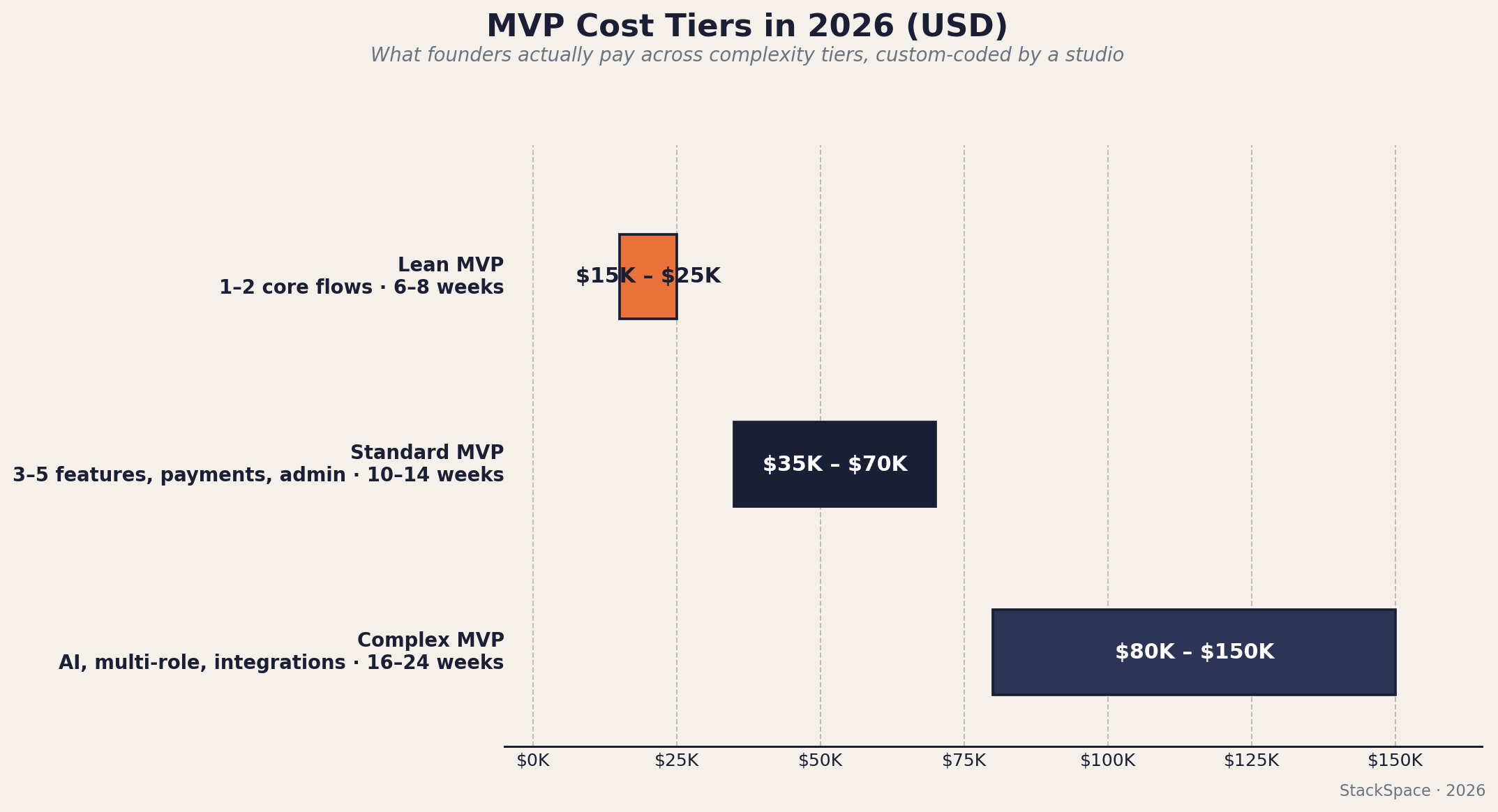
A custom-coded MVP in 2026 costs between $15,000 and $150,000 (roughly ₱840,000 to ₱8.4M PHP) depending on complexity, integrations, and who builds it. The most common range — what we see across founders shipping a real first version — sits between $35,000 and $70,000 for a "Standard MVP" with three to five core features, payments, and an admin layer. No-code builds undercut that on day one and usually cost more by year two. Custom builds in the Philippines usually outperform offshore freelancers on total project cost when scope ambiguity is real.
This post breaks down what's inside those numbers — the tiers, the components, the build-team trade-offs, and the hidden costs founders most often miss when they sign their first quote.
The Three MVP Cost Tiers in 2026
Every MVP we've scoped at StackSpace lands in one of three tiers. The tier is set by feature count, integration count, and how many distinct user roles need a meaningfully different experience — not by industry or how big the founder's vision is.
| Tier | Scope | Cost (USD) | Cost (PHP) | Timeline |
|---|---|---|---|---|
| Lean MVP | 1–2 core flows, single user role, off-the-shelf auth and payments | $15K – $25K | ₱840K – ₱1.4M | 6–8 weeks |
| Standard MVP | 3–5 features, payments, basic admin, email/notifications, one or two integrations | $35K – $70K | ₱2M – ₱3.9M | 10–14 weeks |
| Complex MVP | Multi-role workflows, AI features, multi-tenant or marketplace logic, 3+ integrations | $80K – $150K+ | ₱4.5M – ₱8.4M+ | 16–24 weeks |
The most common mistake is founders misclassifying themselves. "I just need a simple MVP" almost always describes a Standard build once you write down the actual feature list — payments, an admin view, email, role-based access, and one or two integrations push every "simple" idea into the $35K+ band.
A useful tier-check: if your MVP needs to collect money, manage users with different permissions, send notifications, and report on activity, you are in the Standard tier or higher. Pricing for less than that should make you skeptical, not relieved.
What's Actually Inside a Standard MVP
Custom MVP cost is not one bill. It's the sum of six work phases, each with its own deliverable and its own pull on the budget. Skipping or underfunding any of them shows up later — usually as rework, usually at three times the cost.
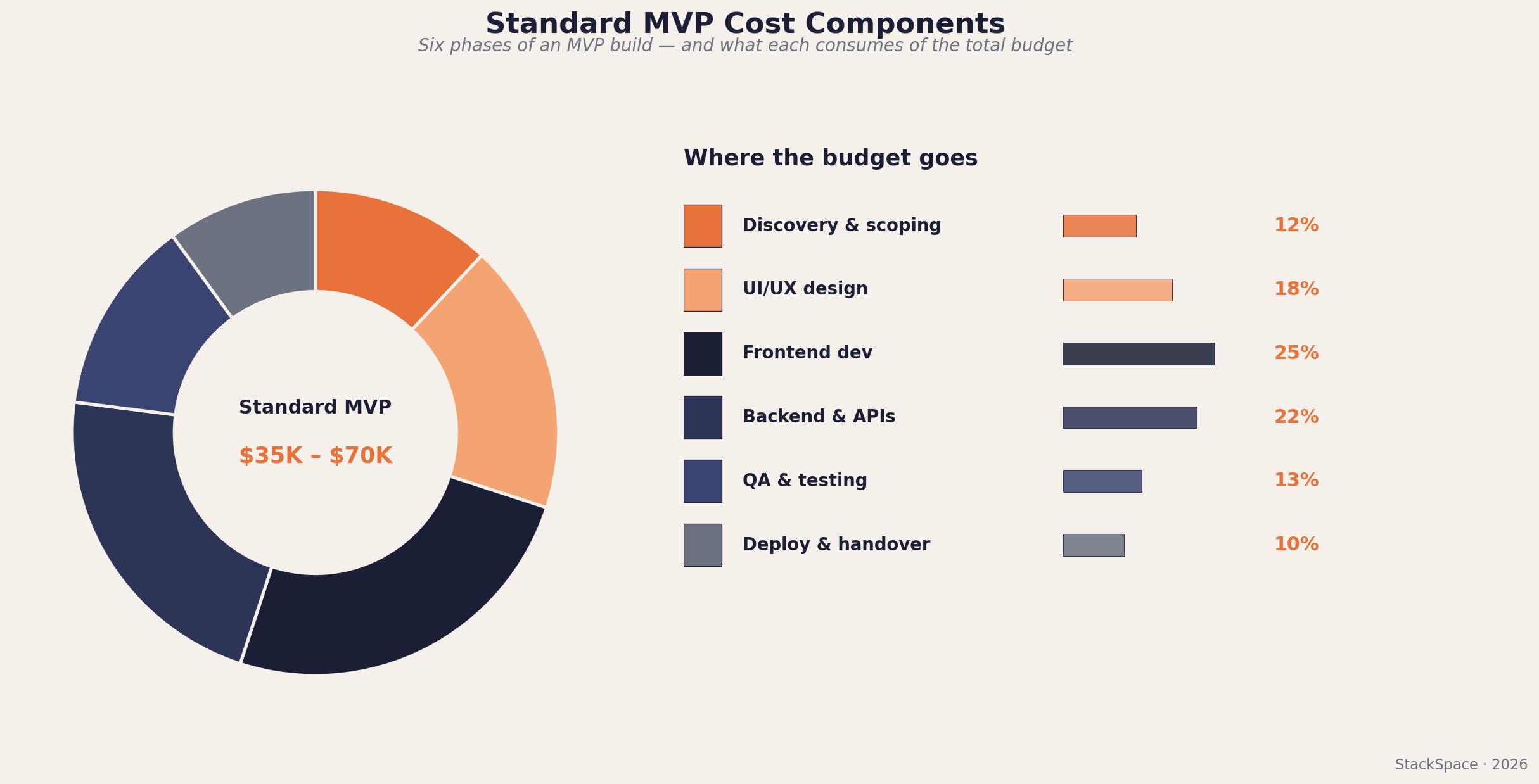
Discovery and scoping (10–15%)
Before anyone writes code, the build team has to translate a founder's pitch into a written specification — feature list, user flows, data model sketch, integration inventory, explicit non-goals. Skipping discovery is the single biggest predictor of budget overruns. We covered our own approach to this in How We Scope a Custom Software Project in 48 Hours — the short version is that two days of structured scoping is cheap insurance against twelve weeks of rework.
UI/UX design (15–20%)
High-fidelity screens, a small component library, mobile-responsive layouts, and a clickable prototype the founder can show to early users before any backend work begins. Underfunded design is the second most common rework trigger we see — beautiful Figma frames that haven't been pressure-tested against real flows generate expensive change orders the moment users touch them.
Frontend development (20–25%)
The interface layer — typically Next.js for web, React Native or Flutter for mobile. This is where most of the visible polish lives, and the layer where AI-assisted tooling has compressed timelines the most aggressively in the last two years. (We compared the major options in Next.js vs React Native vs Flutter.)
Backend, data model, and APIs (20–25%)
Auth, business logic, the database, the API layer, and any integrations with payment, email, or third-party services. This is the layer where shortcuts hurt the most: a poorly modeled database costs nothing to ship and a fortune to migrate at scale.
QA and testing (10–15%)
Functional testing, integration testing, basic load and security checks, and user-acceptance testing with the founder. If a quote does not list QA as a separate line item, ask where it is hidden — or assume it is not there.
Deployment and handover (5–10%)
Production environment setup, monitoring, deploy pipelines, founder training, and the handover documentation a non-technical founder needs to actually own the product after the build team steps back.
A quote that does not break out these six phases is not an MVP quote — it's a guess in a tuxedo.
What MVP Features Actually Cost
Most founders walking into a discovery call have the same five-feature wishlist. Here is what each one realistically costs as a line item inside a Standard MVP, before stacking and integration overhead.
| Feature | Typical cost (USD) | Typical cost (PHP) | Notes |
|---|---|---|---|
| Auth (email, social, SSO) | $1,500 – $4,000 | ₱85K – ₱225K | Use Clerk or Supabase Auth — building custom saves zero dollars and costs 2–4 weeks |
| Payment integration (Stripe / PayMongo) | $3,000 – $8,000 | ₱170K – ₱450K | Subscription billing pushes toward the upper end |
| Admin dashboard | $5,000 – $15,000 | ₱280K – ₱840K | Cost scales with the number of resources and reporting needs |
| Email + notifications | $1,500 – $5,000 | ₱85K – ₱280K | Transactional via Resend or Postmark; SMS via Twilio adds usage cost |
| File upload + storage | $2,000 – $6,000 | ₱110K – ₱335K | S3 or Supabase Storage; image processing adds cost |
| Search and filtering | $3,000 – $10,000 | ₱170K – ₱560K | Postgres full-text is cheap; Algolia or Meilisearch raises the floor |
| Real-time chat or notifications | $6,000 – $18,000 | ₱335K – ₱1M | Pusher or Ably keeps cost down vs. building the socket layer in-house |
| AI feature (LLM-backed) | $8,000 – $25,000 | ₱450K – ₱1.4M | Adds inference cost that recurs monthly — model with care |
| Mobile app shell (iOS + Android) | $15,000 – $40,000 | ₱840K – ₱2.2M | Cross-platform via React Native or Flutter cuts ~40% vs. native |
| Analytics and basic reporting | $2,500 – $8,000 | ₱140K – ₱450K | PostHog or Mixpanel for events; custom dashboards for KPIs |
The numbers above assume a Philippine studio at studio rates — see our 2026 Philippine developer rate guide for the underlying labor inputs. They will be 2–3x higher with a US/EU agency and 30–50% lower with a single offshore freelancer (with the trade-offs we cover below).
The key planning move: do not add every line in this table and call it a budget. The point of an MVP is to ship the smallest combination of features that proves the core hypothesis. Most successful MVPs we've shipped use four or five of these line items, not nine.
MVP Cost by Build Approach
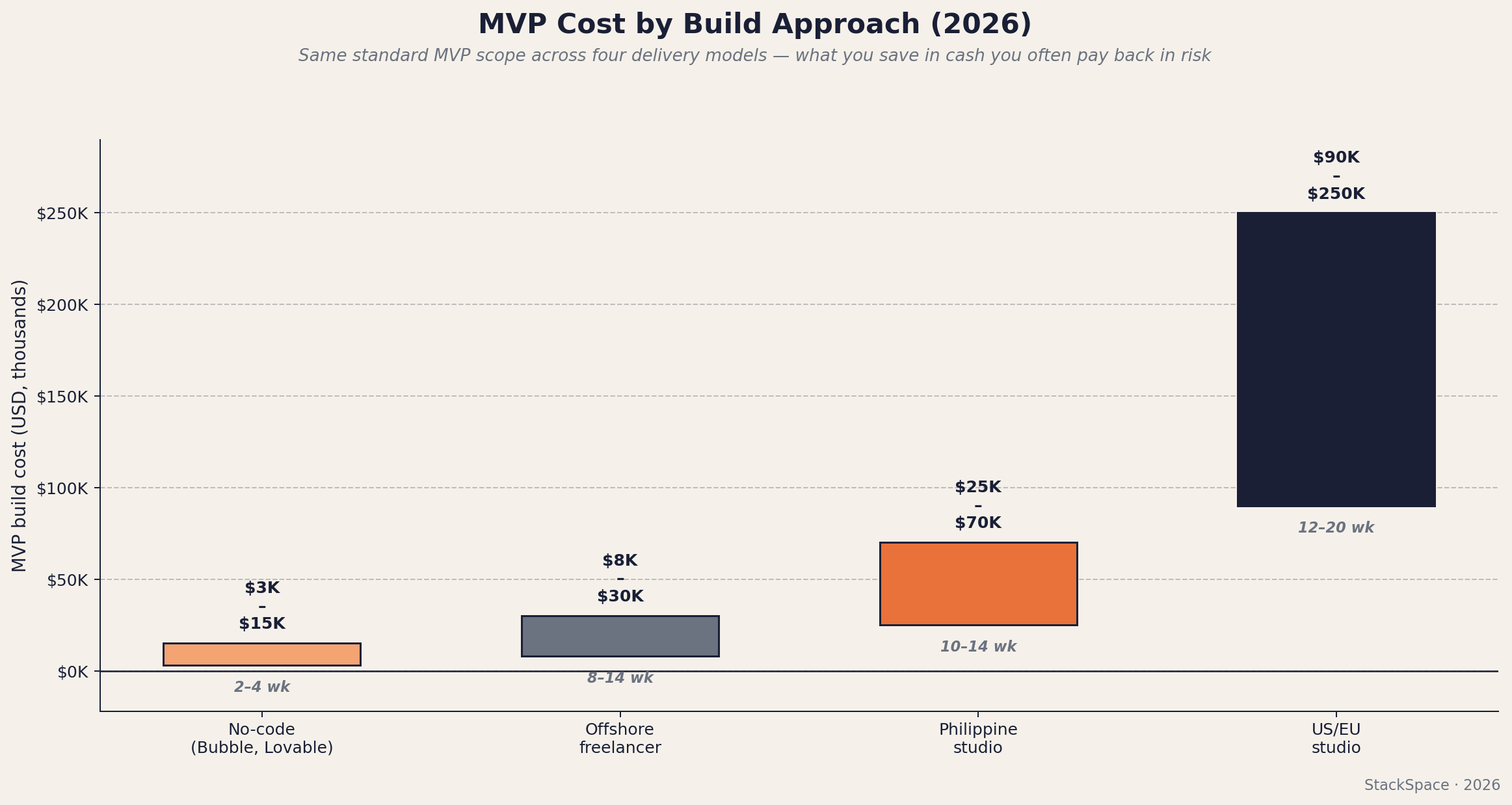
The same scope can cost wildly different amounts depending on who builds it. Here are the four practical paths a founder considers in 2026, with realistic ranges for the same Standard MVP feature set.
No-code platform (Bubble, Lovable, FlutterFlow, Glide)
Cost: $3K–$15K · Timeline: 2–4 weeks
Right call when the goal is to validate demand fast and the product itself is not the moat. Limitations show up at the inflection point — industry data shows roughly 25–30% of no-code MVPs get rewritten in custom code within two years, with rebuild costs of $50K–$250K. If the MVP works, you're paying twice. If it fails, you saved nothing.
Best for: idea validation, internal tools, throwaway prototypes, founders without budget for a proper build.
Offshore freelancer (Upwork, Toptal, direct)
Cost: $8K–$30K · Timeline: 8–14 weeks
Cheapest in cash terms, highest variance in outcome. Works well for very tight, well-specified scopes where the founder is technical enough to manage a contractor. Falls apart fastest under scope ambiguity, integration complexity, or any need to iterate on what "done" means mid-project. There is no QA layer unless the founder builds one. There is no second set of eyes on architecture decisions.
Best for: clearly specified single-feature builds, founders with engineering experience.
Philippine studio (StackSpace and peers)
Cost: $25K–$70K · Timeline: 10–14 weeks
Same time zone as the founder for Asian markets, native English, mature studio process, and a price floor 60–80% below US/EU equivalents. The studio premium over a freelancer buys you a unified team that has shipped the same auth, payments, and admin patterns dozens of times — which translates to fewer architecture decisions revisited mid-project and a QA layer that catches bugs before the founder does.
Best for: founders who want a professional build without a US-agency budget; products where local context matters; anything above the "single feature, well-specified" bar.
US / EU studio
Cost: $90K–$250K · Timeline: 12–20 weeks
Premium price for premium polish, strong design culture, and zero communication friction for US founders. The math gets harder to justify when 60–70% of the work is workstreams a senior Philippine team handles at the same standard for a third of the cost. Worth the premium when the product is a brand-defining surface for a US audience and the design bar is the actual differentiator.
Best for: well-funded startups in the US/EU where the founder's network expects a US-built product.
Hidden Costs Most Quotes Don't Show
The build cost is roughly 70% of what the MVP actually costs in its first 12 months. The rest hides in places founders rarely budget for upfront.
| Cost category | Typical monthly range | Notes |
|---|---|---|
| Cloud hosting (Vercel, AWS, Supabase) | $50 – $500 | Scales with traffic; AI features push the upper end |
| Third-party services (Stripe, Twilio, Resend, Clerk) | $100 – $1,500 | Mostly usage-based; scales with active users |
| LLM / AI inference (OpenAI, Anthropic) | $200 – $5,000 | Easy to underestimate by 5–10x — instrument early |
| Maintenance retainer | $500 – $3,000 | Bug fixes, security patches, dependency updates |
| Iteration and new features | $1,500 – $8,000 | Where most founders' budgets actually go after launch |
| Domain, SSL, monitoring tools | $30 – $200 | Cheap individually, easy to forget collectively |
A working rule we use with clients: budget 20–30% of the build cost annually for the first two years of operation. A $50K MVP should expect $10K–$15K per year in hosting, services, and maintenance — before any new feature work. Founders who do not plan for this number end up rationing fixes and shipping new features against an unsupported codebase.
For a deeper look at total cost of ownership across the full software lifecycle, see The True Cost of Building a Custom Web Application.
Why MVPs Go Over Budget
The MVP cost ranges above assume a disciplined build. Most overruns come from a small set of predictable causes — and almost all of them are scope-related, not technical.
Scope creep. The single biggest killer. Industry research shows scope creep affects roughly 80% of MVPs and can extend timelines by 40–60%. Each added feature feels small in isolation. Cumulatively they push a 12-week project to 20 and double the budget. A scope discipline that says "every new request becomes a v2 ticket unless it's a bug" is worth more than any technical decision.
Underspecified requirements. "Build me a marketplace MVP" is not a spec — it's a prompt. Without explicit user flows, edge cases, and non-goals on paper, the build team makes assumptions, the founder objects to those assumptions in week 8, and the rework starts. The fix is upfront discovery, not better mid-project communication.
Integration surprises. Every third-party API has its own quirks, rate limits, and gaps in documentation. Founders consistently underestimate integration time by 2–3x. A useful planning rule: assume one to three weeks per major integration, in addition to the feature work that uses it.
Premature scale work. Building Kubernetes-grade infrastructure for an MVP that will serve fifty users in its first six months is a common form of over-engineering. A simple stack (Next.js + Postgres + Vercel + Supabase) handles the first 1,000 users for almost any product. Start there.
Insufficient QA. Cutting QA to save 10% of the build cost reliably costs 20–30% in post-launch bug fixes — when those fixes are also more expensive because they happen under live user pressure.
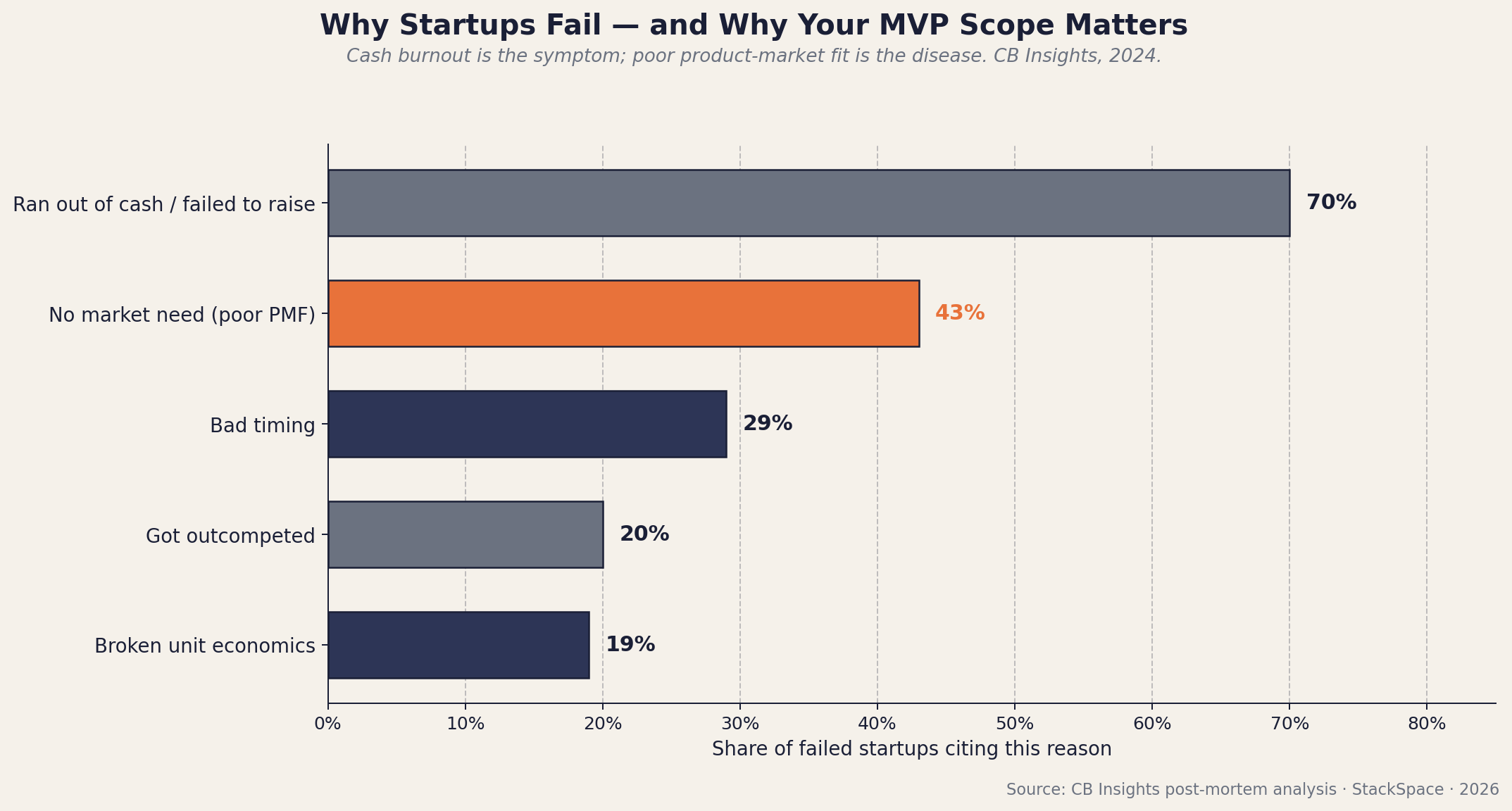
The bigger picture matters too. CB Insights' 2024 update found that 43% of failed startups failed because of poor product-market fit, and 70% ran out of cash — but cash burn is usually the symptom, not the disease. Startups that ship a small, well-scoped MVP get to product-market fit signal faster, with more runway left to act on it. An overscoped MVP burns the runway you needed to find PMF.
How AI-Assisted Development Has Changed MVP Pricing
AI coding tools — Cursor, GitHub Copilot, Claude Code — have measurably compressed delivery timelines on the kinds of work an MVP needs most. McKinsey's 2025 research puts the productivity gain at 40–60% for teams that have integrated AI tooling well. We see a similar number on our own builds. What that means in practice for founders:
- Lean MVPs that used to take 8 weeks now ship in 5–6. Pricing has not collapsed proportionally — most studios have absorbed the gain as margin or invested it in higher-quality QA. A few have passed it through as faster timelines at unchanged price.
- Standard MVPs see compressed mid-project rework. Refactors, second-pass cleanup, and migration work all get cheaper. The biggest savings are post-launch.
- The bar for an "MVP" has risen. What would have been a Standard MVP in 2022 — auth, payments, admin, three core flows — is now expected to be polished, mobile-responsive, and fast on day one. AI tooling is what makes that bar reachable on the same budget.
What hasn't changed: AI does not write your spec, run discovery, or decide what to cut. The founder-side work is still the founder-side work.
A Practical MVP Budgeting Framework
Here is the actual calculation we walk founders through before quoting anything.
Step 1 — Write down the user flows. List the three to five things a real user must be able to do for the MVP to deliver value. Anything else is v2.
Step 2 — Pick a tier. Use the tier table above. Be honest. If your MVP needs payments and a separate admin view, you are not in the Lean tier.
Step 3 — Add integration overhead. For each external system the MVP must talk to (payment, email, SMS, AI, CRM, accounting), add $2K–$8K depending on complexity. Most founders forget at least one of these.
Step 4 — Add a 20% contingency. Every first-time build surfaces unforeseen complexity. A 20% buffer is the difference between "we hit our number" and "we ran out of money in week 10."
Step 5 — Budget post-launch operations. Add 20–30% of build cost per year for hosting, services, and maintenance. A $50K MVP needs ~$1K/month set aside on day one of launch.
Step 6 — Get two or three quotes. Compare the breakdowns, not the bottom lines. The cheapest quote is rarely the cheapest outcome. Look for the one with QA as a separate line, an explicit discovery phase, and a written change-order process.
Frequently Asked Questions
How much does a basic MVP cost in 2026?
A basic, custom-coded MVP with one or two core flows and standard auth costs $15,000 to $25,000 USD (₱840K to ₱1.4M PHP) built by a Philippine studio. No-code MVPs can come in lower at $3K–$15K but typically get rewritten within 18–24 months if the product takes off, costing $50K+ to rebuild.
How long does it take to build an MVP?
A Lean MVP ships in 6–8 weeks, a Standard MVP in 10–14 weeks, and a Complex MVP with AI features or multi-role workflows in 16–24 weeks. AI-assisted development has compressed these timelines by 40–60% over the last two years. If a quote promises a Standard MVP in 4 weeks, it is either over-promising or under-scoped.
What features should an MVP include?
A Standard MVP typically includes user authentication, three to five core feature flows, a payment or subscription integration, an admin dashboard, transactional email or notifications, and basic analytics. Features that are not directly required to validate the core hypothesis should be cut to v2. The 70% rule: ship the 20% of features that prove 80% of the value.
Why is custom MVP development cheaper in the Philippines?
Philippine studios charge 60–80% less than US/EU equivalents because of local labor cost differences, while delivering on the same engineering stack with native English communication. A Standard MVP that runs $90K–$250K with a US studio runs $25K–$70K with a Philippine studio of comparable seniority. See our breakdown of Philippine developer rates in 2026 for the underlying numbers.
Should I use no-code or custom code for my MVP?
Use no-code when the goal is fast validation and the product itself is not the moat — internal tools, demand tests, throwaway prototypes. Use custom code when software is the competitive advantage, when scale is plausible within 12 months, or when the cost of rebuilding later would exceed the savings now. About 25–30% of no-code MVPs end up rewritten in custom code within two years.
What hidden costs should I plan for after MVP launch?
Budget 20–30% of your build cost per year for hosting, third-party services, AI inference, and maintenance. A $50K MVP typically incurs $10K–$15K annually in operating cost before any new feature work. The most commonly underestimated line items are LLM inference (often 5–10x what founders forecast) and dependency maintenance.
Does StackSpace charge for scoping?
No. We run a 48-hour scoping sprint free for every qualified project after a 30-minute consultation call. We only build projects above ₱500,000 in build value, and at that scale a properly scoped engagement is worth far more to both sides than a fee on the front end. The scoping document is the founder's to keep, whether they build with us or not — see How We Scope a Custom Software Project in 48 Hours for the playbook.
Final Thoughts
MVP cost in 2026 is less about the sticker price and more about scope discipline. The founders who get the best outcomes are the ones who treat their MVP as a small, focused experiment — three to five features, one well-defined user, a clear hypothesis to validate — and resist the gravitational pull of "while we're at it" feature requests during the build.
If your MVP idea fits a Standard build (and most do), expect to spend $35,000 to $70,000 to ship it well, with another $10,000 to $20,000 in operating cost over the first year. Anything significantly cheaper deserves a hard look at what's missing. Anything significantly more expensive deserves a hard look at what's been added that does not need to be in v1.
If you want a real number for your specific idea, book a free consultation call and we'll walk you through what a Standard MVP would actually cost for your scope. No boilerplate quote — just a tier, a feature list, and a number you can plan around.
Written by
Jabez Borja
More articles
How to Evaluate If Your Business Is Ready for AI Automation
A practical AI readiness assessment for business owners — the five dimensions that decide whether automation will pay off, a self-scoring scorecard, a step-by-step assessment process, and the green lights and red flags to check before you build.
Hidden Costs of Software Development Nobody Warns You About
The line items that don't show up in a software quote but blow up the budget anyway — maintenance, infrastructure, scope creep, integrations, and more. A 2026 breakdown with realistic ranges and a pre-signature checklist.
Our Tech Stack for Building Client Projects in 2026: Tools, Infra, and Why
A transparent look at the tech stack StackSpace uses to build client projects in 2026 — the frontend, backend, database, infrastructure, and AI tools we default to, the criteria we choose them on, and where we deliberately deviate.
Want to build something?
We help businesses turn ideas into production software. Book a discovery call and let's talk about your project.