
Software Developer Rates in the Philippines: 2026 Market Guide
Real 2026 rates for hiring software developers in the Philippines — by experience, role, region, and engagement model. Built from current market data, not last year's blog posts.

What Software Developers Actually Cost in the Philippines (2026)
A mid-level Philippine software developer in 2026 costs between ₱50,000 and ₱90,000 per month ($870–$1,560 USD) on a local employment contract, or $28–$45 per hour ($4,800–$7,800 monthly) when contracting directly to a foreign client. Senior engineers run ₱90,000–₱160,000 locally and $40–$65 per hour internationally. Studio-blended rates — covering developers, project management, QA, and overhead — typically sit at ₱2,000–₱5,000 per hour ($35–$87).
Those are the headline numbers. The rest of this guide is the specifics: rates by specialization, regional differences between Manila, Cebu, and Davao, what changes when you hire through a studio versus direct, and the all-in cost picture once benefits and statutory contributions are included.
The data is current as of April 2026, drawn from Sprout HR's Philippine Salary Guide, IBPAP's 2028 Industry Roadmap, JobStreet, Second Talent, Lemon.io, and our own observations from running a Manila-based software studio.
The 2026 Philippine Developer Market in One Picture
Before the rate tables, context. You're hiring into a market that grew faster than the global average last year and is on track to keep doing so.
The IT-BPM industry in the Philippines closed 2025 at roughly $40 billion in export revenue and 1.9 million workers, according to IBPAP. Both metrics outpaced the global outsourcing average — revenue grew 5%, headcount 4%, against a worldwide industry average closer to 3%. IBPAP's roadmap projects the sector to reach $42 billion in 2026 and $59 billion with 2.5 million workers by 2028.
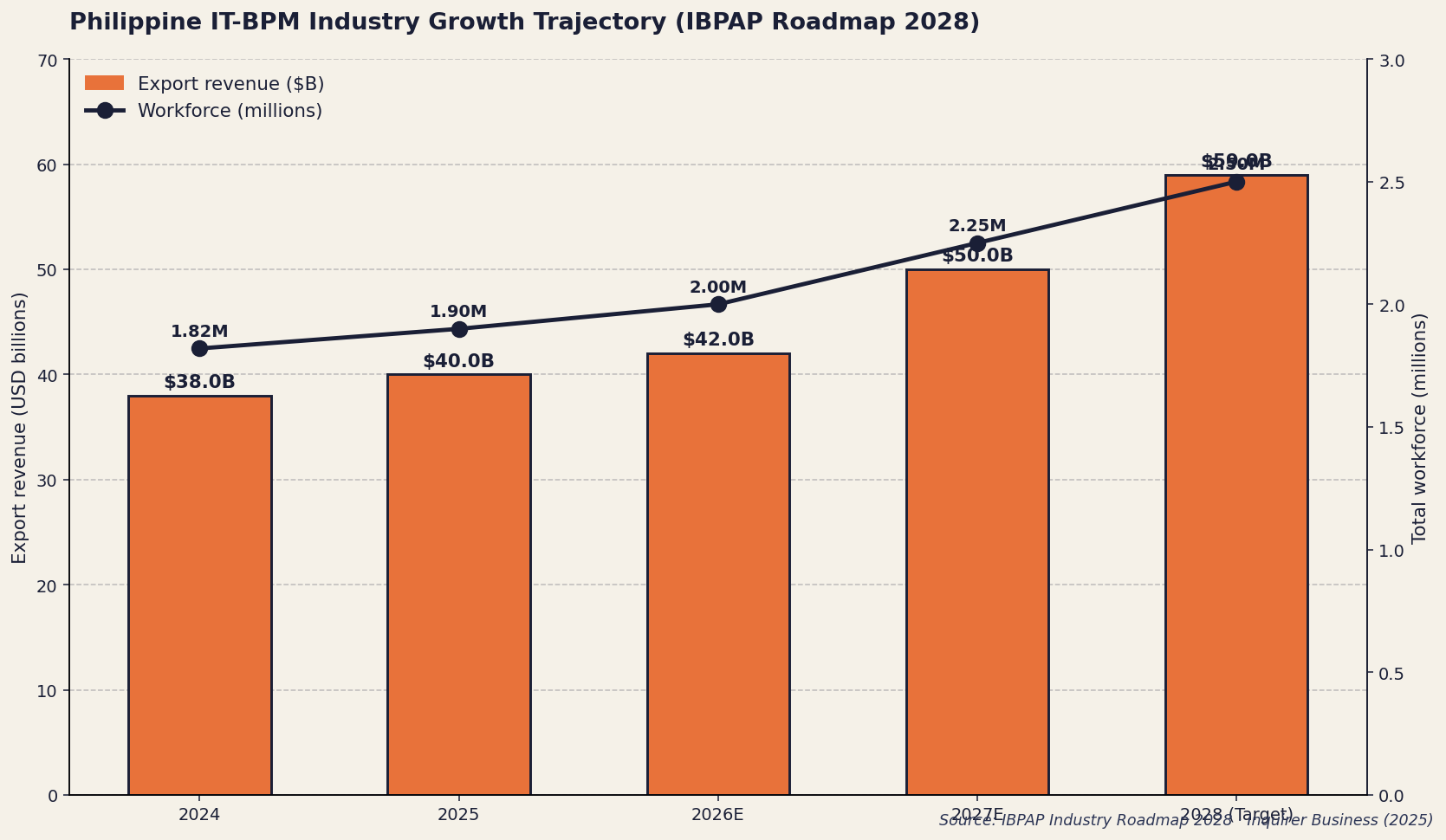
Two things matter for anyone trying to budget a hire:
1. Salary inflation is real but modest. The 2026 salary increase budget across the Philippines sits between 5.2% and 5.5%, against headline inflation of roughly 3.0%. Tech roles tend to land at the higher end of that range — closer to 6–7% — because demand is concentrated.
2. The hiring pool is decentralizing. Manila is still the deepest market, but Cebu, Davao, Iloilo, and Clark are absorbing meaningful headcount as multinationals open regional hubs and remote-first companies stop caring about commute distance from Makati. That has implications for what you pay — and where you'll find a developer who will actually answer your email.
Monthly Rates by Experience Level (Local Employment)
Here's the base picture for a developer hired on a Philippine employment contract — the typical setup if you're a Philippine company, or if you're a foreign company using an EOR (employer of record) like Deel or Remote.
| Experience Level | Monthly Range (PHP) | Monthly Range (USD) | Annual (PHP) |
|---|---|---|---|
| Junior developer (0–2 yrs) | ₱30,000 – ₱50,000 | $520 – $870 | ₱360K – ₱600K |
| Mid-level developer (2–5 yrs) | ₱50,000 – ₱90,000 | $870 – $1,560 | ₱600K – ₱1.08M |
| Senior developer (5–8 yrs) | ₱90,000 – ₱160,000 | $1,560 – $2,800 | ₱1.08M – ₱1.92M |
| Lead / Architect (8+ yrs) | ₱140,000 – ₱250,000+ | $2,440 – $4,350+ | ₱1.68M – ₱3M+ |
| Engineering Manager | ₱150,000 – ₱280,000 | $2,610 – $4,870 | ₱1.8M – ₱3.36M |
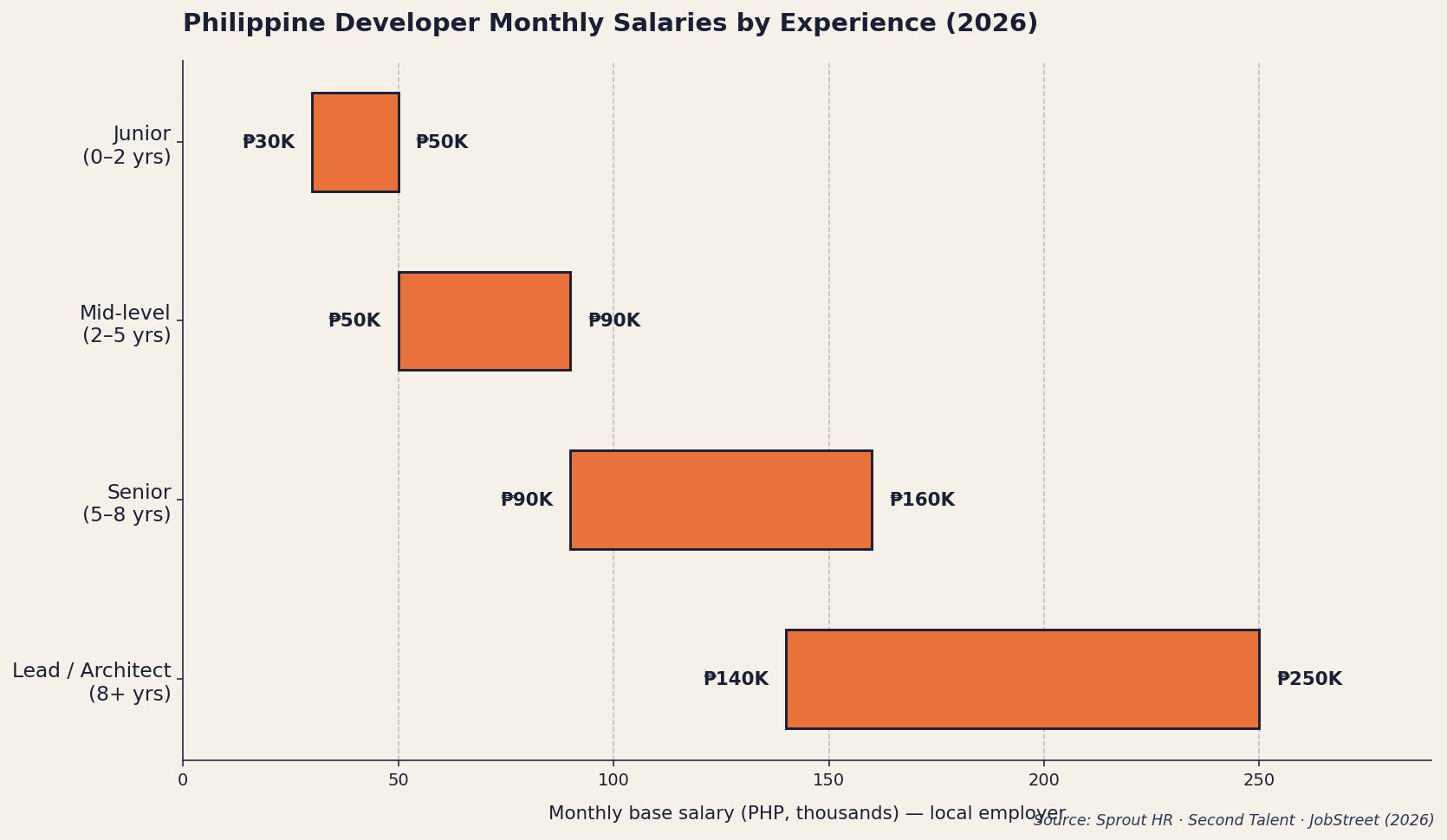
A few things to flag about this table:
- These are base salaries only. Total cost of employment is roughly 1.25–1.40x the base once you add 13th-month pay, statutory contributions, HMO, and bonuses. We break that out further down.
- The "Lead/Architect" range is wide because it pulls in everyone from a five-person team lead to a principal engineer at a multinational. The top of the band is real but uncommon.
- Specializations like AI/ML, security, and certain DevOps niches push you 20–40% above these numbers at the senior end.
Hourly Rates: Direct Contract to Foreign Clients
If you're hiring a Philippine developer as an independent contractor — paid in USD, working remotely for a US, EU, AU, or SG client — the rate structure is different. The developer is taking on tax and benefits responsibility themselves, and is often charging closer to a small-business rate than a salary equivalent.
| Experience Level | Hourly Rate (USD) | Effective Monthly (USD) | vs. Local Equivalent |
|---|---|---|---|
| Junior (0–2 yrs) | $18 – $25 | $3,000 – $4,200 | ~3.5–5x local base |
| Mid-level (2–5 yrs) | $28 – $45 | $4,800 – $7,600 | ~3–5x local base |
| Senior (5–8 yrs) | $40 – $65 | $6,800 – $11,000 | ~3–4x local base |
| Specialist / Architect (8+ yrs) | $55 – $90 | $9,300 – $15,300 | ~3x local base |
The 3–5x premium over local employment isn't pure margin going to the developer. They're absorbing:
- Self-paid taxes (~8% optional graduated rate on professional income, plus VAT above ₱3M annual revenue)
- Self-paid benefits — no employer-sponsored HMO, no 13th month, no retirement contributions
- Currency and payment risk — getting paid in USD via Wise or Payoneer carries small but real costs
- Income volatility — contract work doesn't carry the same stability as permanent employment
- No paid leave — vacation time is unpaid time
That's why a developer who'll happily work for ₱70,000 monthly on a local contract may quote $40/hour ($6,800 monthly) for the same work as a contractor. It's not a contradiction — it's the same person priced for two different risk profiles.
Rates by Specialization
Generalist rates are useful for budget math, but real hiring is specialization-specific. Here's what 2026 looks like by stack and role for direct-contract foreign work.
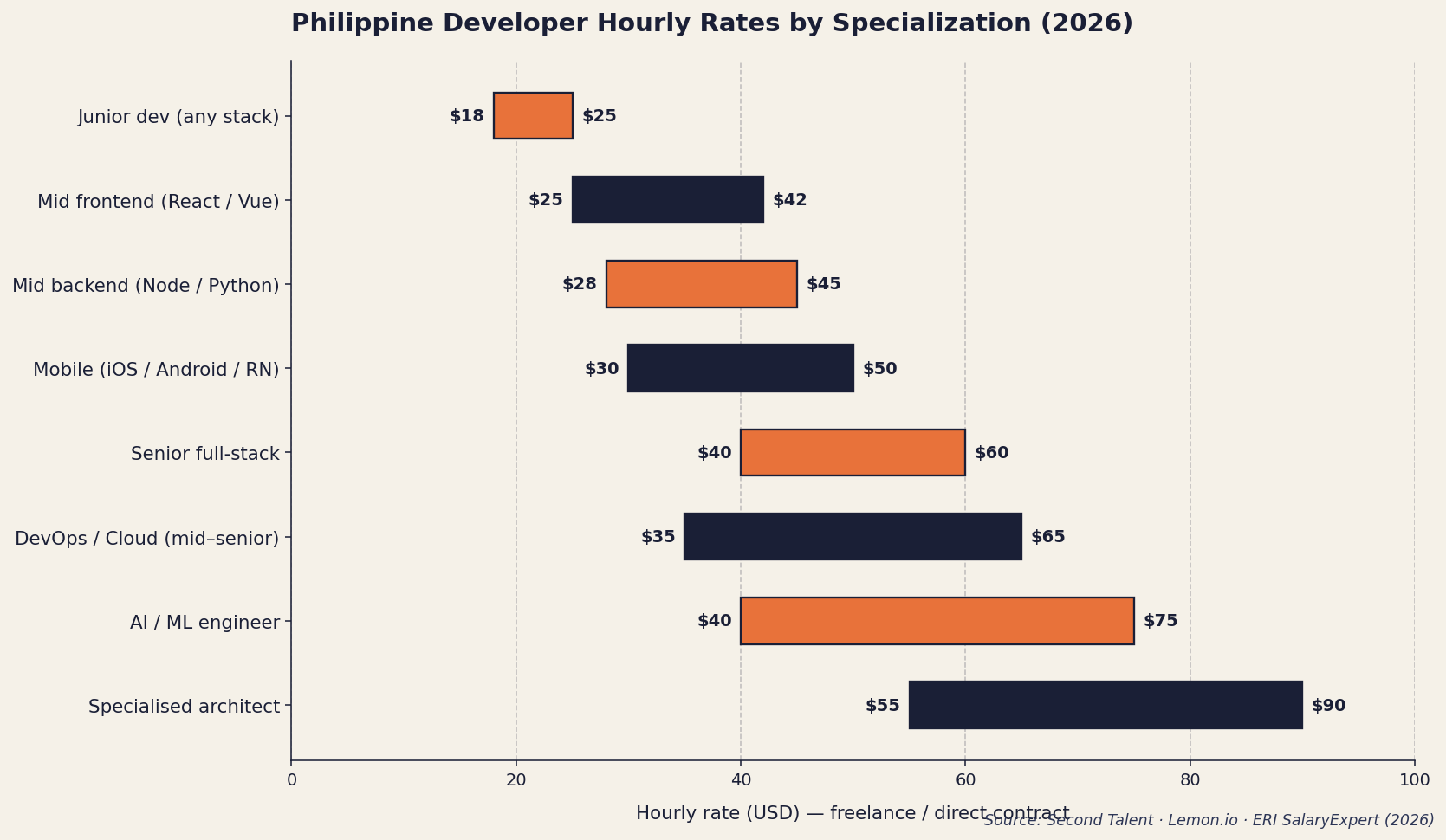
| Specialization | Hourly (USD) | Monthly Local (PHP) | Demand Level |
|---|---|---|---|
| Frontend (React, Vue, Next.js) | $25 – $50 | ₱45K – ₱110K | Very high |
| Backend (Node.js, Python, Go) | $28 – $55 | ₱55K – ₱130K | Very high |
| Full-stack (mid-senior) | $35 – $60 | ₱65K – ₱140K | Extremely high |
| Mobile (iOS, Android, React Native, Flutter) | $30 – $50 | ₱60K – ₱130K | High |
| DevOps / Cloud (AWS, GCP, Azure) | $35 – $75 | ₱70K – ₱200K | High, supply-constrained |
| AI / ML engineer | $40 – $85 | ₱60K – ₱180K | Extremely high, supply-constrained |
| Data engineer | $35 – $65 | ₱65K – ₱160K | High |
| Security engineer | $40 – $80 | ₱75K – ₱200K | High, supply-constrained |
| QA engineer (manual + automation) | $18 – $35 | ₱40K – ₱90K | Moderate |
| UI/UX designer | $22 – $50 | ₱40K – ₱120K | High |
Three patterns worth noting:
Full-stack JavaScript is the deepest pool. React + Node.js is the most populated specialization in the Philippine market right now, which is why it's the cheapest serious-quality option. If your stack matches, you'll have your pick of candidates within two weeks. If it doesn't — Elixir, Rust, niche enterprise systems — expect a longer search and a meaningful premium.
AI/ML and DevOps are supply-constrained. Local universities are ramping up AI/ML programs, but the experienced senior pool is small. Anyone with two solid LLM-application projects on their CV right now can clear ₱180K monthly without much effort. DevOps with real production AWS or GCP experience is similar.
QA is undervalued and underpriced. Many companies still treat QA as a cost center to minimize. Skilled automation engineers — Cypress, Playwright, Selenium with proper CI integration — are worth far more than the rates suggest, and the market is starting to reflect that.
Regional Variation: Manila vs Cebu vs Davao
The "Philippines" in "Philippine developer rates" hides meaningful regional variation. Where someone is based affects their salary expectation by 10–30%.
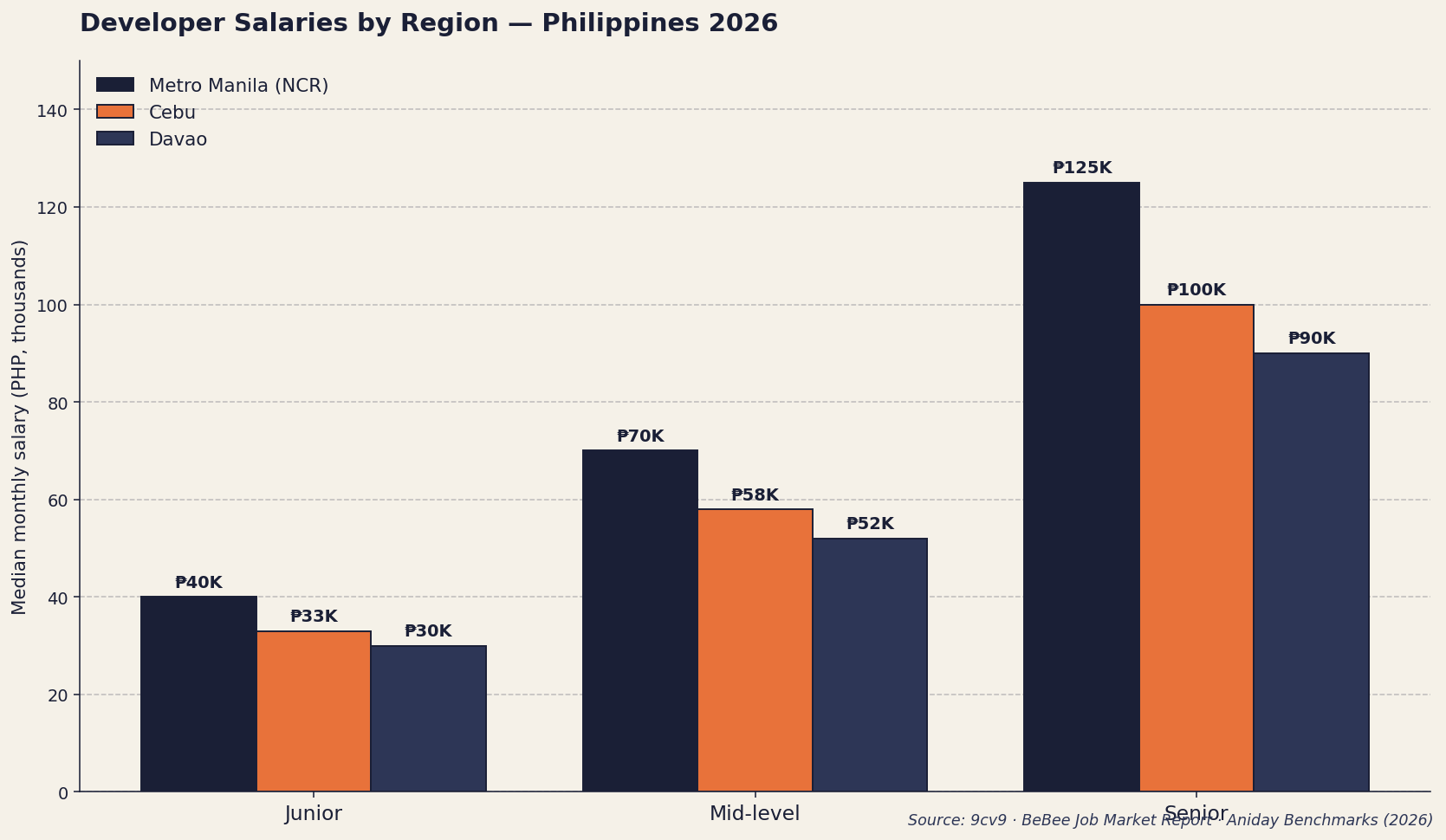
| Region | Junior (PHP/mo) | Mid (PHP/mo) | Senior (PHP/mo) | Cost-of-Living Index |
|---|---|---|---|---|
| Metro Manila (NCR) | ₱35K – ₱55K | ₱60K – ₱95K | ₱100K – ₱160K | 100 (baseline) |
| Cebu | ₱28K – ₱45K | ₱48K – ₱78K | ₱80K – ₱130K | ~78 |
| Davao | ₱25K – ₱40K | ₱42K – ₱70K | ₱72K – ₱115K | ~72 |
| Iloilo / Bacolod | ₱25K – ₱40K | ₱42K – ₱68K | ₱70K – ₱110K | ~70 |
| Clark / Pampanga | ₱30K – ₱48K | ₱52K – ₱82K | ₱85K – ₱135K | ~80 |
A few practical notes:
Remote work has compressed the differential. Five years ago, hiring in Davao for a Manila-based company saved you 30%. Today, a senior developer in Davao who can work for any global company will quote within 10–15% of their Manila peer. The geographic discount only fully shows up for in-office or hybrid roles tied to a local employer.
Cebu is the strongest non-NCR market. It now has a meaningful concentration of fintech, BPO-tech, and SaaS firms. Quality of senior talent in Cebu is comparable to Manila for most stacks, and the cost-of-living advantage is real for the developer.
Don't optimize purely for region. A great Davao mid-level engineer is worth more than an average Manila one. We've made the mistake of using regional rates as a hard ceiling and ended up rejecting strong candidates over ₱5,000 monthly. It's almost never worth it.
The Real Cost of Employment: What Goes On Top of Base Salary
The salary tables above are base monthly rates. Total cost of employment in the Philippines includes mandatory and customary additions that can add 25–40% to the headline number.
| Cost Component | Typical Cost | Notes |
|---|---|---|
| 13th-month pay (mandatory) | 1/12 of annual base = 8.33% | Required by law; paid every December |
| SSS, PhilHealth, Pag-IBIG (employer share) | ~10–13% of base | Capped contributions; effective rate decreases at higher salaries |
| HMO (health insurance) | ₱20K – ₱60K per year | Standard market expectation; varies by coverage tier |
| Performance / year-end bonus | 0.5 – 2 months of base | Customary in tech, not legally required |
| Equipment / WFH allowance | ₱20K – ₱80K per year | Laptop refresh, internet stipend, ergonomic gear |
| Paid leave (vacation + sick) | 10–15 days each, paid | Most tech companies offer above the legal minimum |
| Recruitment cost (one-time) | 1–2 months of salary | Either agency fee or internal recruiter time |
The all-in math: a developer with a ₱70,000 base salary actually costs the employer roughly ₱90,000–₱98,000 per month when you include statutory contributions, 13th month pay (amortized monthly), HMO, and a typical year-end bonus. That's the number to use for budgeting headcount, not the base figure on the offer letter.
For reference, our Custom Software Cost guide for the Philippines walks through what those loaded costs translate to at the project level when you're scoping a build with a studio.
Studio-Blended Rates vs Direct Hire vs EOR
The same engineering work gets billed at very different rates depending on how you engage the talent. Here's the practical breakdown.
| Engagement Model | Effective Cost | What's Included | Best For |
|---|---|---|---|
| Direct local hire (you're a PH company) | 1.25–1.40x base salary | Just the developer — you handle everything else | Long-term core team, your primary market is PH |
| EOR (Deel, Remote, Multiplier) | 1.40–1.55x base + $400–$600/mo platform fee | Compliant employment + payroll + benefits | Hiring 1–5 PH developers without a PH entity |
| Direct contractor (USD invoice) | $28–$65/hr × 160 hrs = $4.5K–$10.5K/mo | Just the developer — they handle their own taxes | Short-to-medium term work, specific skills |
| Software studio / agency | ₱2,000–₱5,000/hr ($35–$87) | Dev + PM + QA + design + accountability | Project-based builds, no internal team to manage them |
| Staff augmentation firm | 1.6–2.2x developer's effective salary | Developer + recruitment + retention support | Scaling up an existing team quickly |
The studio-blended rate looks expensive next to a freelance hourly rate, but the comparison is uneven. A studio billing ₱3,500 per hour is covering not just the developer's time but the project manager scoping the work, the QA engineer testing it, the designer handling UI, the technical lead reviewing architecture, and the buffer for someone going on leave mid-sprint without your project stalling.
For a short, well-defined task — fix this bug, add this feature — a contractor is almost always more cost-efficient. For a multi-month build with shifting requirements, the coordination overhead of running a contractor team yourself usually wipes out the rate savings. We've covered the trade-off in more detail in our post on why Philippine startups choose custom software.
Philippines vs Other Outsourcing Markets
The honest comparison against alternative talent markets, with 2026 rates.
| Market | Mid-Level Hourly (USD) | Senior Hourly (USD) | Time Zone Overlap (US East) | English Proficiency |
|---|---|---|---|---|
| Philippines | $28 – $45 | $40 – $65 | ~2 hrs (with shift) | Very high |
| India | $22 – $40 | $35 – $60 | ~3 hrs (with shift) | High |
| Vietnam | $20 – $38 | $32 – $55 | ~2 hrs (with shift) | Moderate |
| Eastern Europe (Poland, Ukraine, Romania) | $45 – $75 | $65 – $100 | ~6 hrs | High |
| Latin America (Brazil, Argentina, Mexico) | $35 – $60 | $55 – $90 | Same / +1–2 hrs | Moderate–high |
| USA / Canada | $95 – $150 | $140 – $220 | Same | Native |
| Western Europe | $80 – $130 | $120 – $180 | ~5 hrs | High |
What the Philippines wins on: rate-for-quality at the mid level, English fluency, US business-culture alignment, and same-day async communication for US/AU clients willing to accept a few hours of overlap. Where it doesn't dominate: pure cost (Vietnam and India undercut at the junior end), or projects needing same-time-zone live collaboration with North America (Latin America wins).
What Drives a Specific Developer's Rate Up or Down
Within the ranges above, individual rates flex based on signals that are usually obvious in hindsight but easy to miss when you're hiring.
Drives rates up:
- Production AI/LLM experience. Anyone with shipped, in-production LLM applications — not just toy projects — commands a 30–50% premium right now.
- Cloud certifications + actual production exposure. AWS Solutions Architect Pro, GCP Professional, or equivalent with verifiable production work.
- Open-source contributions to libraries you're using. Real maintainership, not drive-by PRs.
- Domain expertise — fintech (PCI-DSS, payment integrations), healthcare (HIPAA, PDPA), logistics (route optimization, fleet management).
- Prior work at recognizable Philippine tech employers — Kumu, GCash, Maya, PayMongo, Sprout — signals a stronger filter than university credentials.
Keeps rates down:
- Working on legacy stacks — pure PHP/Laravel, classic .NET, jQuery — without a clear path to modernization in the role.
- Strong general-purpose engineering skills but no public portfolio or contributions.
- Junior to mid transitions where someone is technically experienced but hasn't yet hit their first senior-level salary band.
- Hiring outside the major hubs without a remote-only role.
Frequently Asked Questions
What is the average software developer salary in the Philippines in 2026?
The median monthly salary for software engineers in the Philippines in 2026 is approximately ₱65,000, with the typical range running from ₱30,000 (junior) to ₱160,000 (senior). Mid-level developers with 2–5 years of experience earn ₱50,000–₱90,000 per month on local employment contracts.
How much do Philippine developers charge per hour for foreign clients?
Direct-contract hourly rates for Philippine developers in 2026 range from $18–$25 (junior), $28–$45 (mid-level), $40–$65 (senior), and $55–$90 (specialist/architect). Studio-blended rates from Manila-based agencies typically run $35–$87 per hour depending on the firm.
Are Philippine developer rates increasing in 2026?
Yes. The 2026 salary increase budget across the Philippines is 5.2–5.5%, with tech roles trending higher at 6–7% due to demand concentration. AI/ML and DevOps specializations are seeing double-digit annual increases as supply remains tight against rising demand.
Is it cheaper to hire a freelancer or use a software studio in the Philippines?
For short, well-defined tasks, a freelancer is more cost-efficient. For multi-month builds with evolving requirements, a studio's blended rate often comes out cheaper than the all-in cost of running a freelance team yourself once you account for coordination, QA, project management, and risk of single-person dependency.
How do Manila rates compare to Cebu and Davao?
Manila (NCR) rates run roughly 15–25% higher than Cebu and 20–30% higher than Davao for in-office or hybrid roles. For fully remote roles serving global clients, the regional gap has compressed to 10–15% as developers in any region can charge what their work is worth on the international market.
What's the all-in cost of employing a Philippine developer?
The total cost of employment is typically 1.25–1.40x the base salary once you include the mandatory 13th month pay (8.33%), SSS/PhilHealth/Pag-IBIG employer contributions (~10–13%), HMO (₱20K–₱60K annually), and customary year-end bonus (0.5–2 months of base). A ₱70,000 base salary translates to roughly ₱90,000–₱98,000 in true monthly cost.
Do Philippine developers work in US time zones?
Many do. Philippine BPO and tech professionals have decades of experience working night shifts to align with US business hours. Expect a shift premium of 10–20% for sustained US time-zone work. Mid-shift (overlapping with US morning + Philippine afternoon) is the most common compromise and rarely carries a premium.
What technologies do Philippine developers specialize in?
The deepest pools are JavaScript (React, Node.js, Next.js), Python (Django, FastAPI), mobile (Flutter, React Native, Swift, Kotlin), and PHP (Laravel). Cloud (AWS, GCP), AI/ML, and DevOps specializations are growing rapidly but remain supply-constrained at the senior level. For a deeper look at choosing the right stack, see our guide on choosing between Next.js, React Native, and Flutter.
Practical Hiring Framework: How to Apply These Numbers
Knowing the rates is the easy part. Translating them into a successful hire is harder. Here's the framework we use when scoping a hiring decision for ourselves or for clients.
Step 1 — Pick the engagement model first, not the candidate. Before you look at a single CV, decide whether you need a permanent local hire, a contractor for a defined project, or a studio to deliver an outcome. Each one optimizes for different things, and switching mid-process is expensive.
Step 2 — Anchor on total cost, not headline salary. Use the loaded cost (1.25–1.40x base) for permanent hires, the all-in monthly equivalent for contractors ($/hr × 160), and the project-based quote for studios. Compare these apples-to-apples.
Step 3 — Don't underpay below the floor of the band. Philippine developers know what the market pays. An offer 15% below the mid-band signals either a low-margin operation or a manager who hasn't done their homework — both push good candidates to keep looking. The savings rarely survive the second hire when the first one quits within six months.
Step 4 — Pay above market for scarce skills. AI/ML, senior DevOps, and security engineers are paid above their generalist peers for a reason — supply is tight and getting tighter. Don't try to anchor a hire in these categories on generalist mid-band rates.
Step 5 — Budget for retention, not just acquisition. A senior developer who leaves at month 18 costs you more than the 10–15% raise that would have kept them. Annual reviews with meaningful adjustments aren't a perk — they're cheaper than recruiting again.
Final Thoughts
Philippine developer rates in 2026 sit in a sweet spot: meaningfully cheaper than North American or Western European hiring, comparable in quality at the mid-to-senior level, and supported by an industry growing faster than the global average. The market isn't dirt cheap and hasn't been for years — but the value-for-money math still works for businesses that approach hiring with realistic expectations.
The biggest mistake we see foreign companies make is treating Philippine talent as a budget play first. The companies that build durable engineering teams here approach it as a quality decision that happens to be cost-efficient — and they pay enough to keep the people they hire.
If you're scoping a hire — direct, contract, or via a studio — and want a straight conversation about what your specific role is worth in 2026, reach out to us. We'll tell you what we'd actually pay for the same work, and what we'd expect to pay for it 18 months from now.
Written by
Jabez Borja
More articles
How to Evaluate If Your Business Is Ready for AI Automation
A practical AI readiness assessment for business owners — the five dimensions that decide whether automation will pay off, a self-scoring scorecard, a step-by-step assessment process, and the green lights and red flags to check before you build.
Hidden Costs of Software Development Nobody Warns You About
The line items that don't show up in a software quote but blow up the budget anyway — maintenance, infrastructure, scope creep, integrations, and more. A 2026 breakdown with realistic ranges and a pre-signature checklist.
Our Tech Stack for Building Client Projects in 2026: Tools, Infra, and Why
A transparent look at the tech stack StackSpace uses to build client projects in 2026 — the frontend, backend, database, infrastructure, and AI tools we default to, the criteria we choose them on, and where we deliberately deviate.
Want to build something?
We help businesses turn ideas into production software. Book a discovery call and let's talk about your project.