
How AI Agents Are Transforming Business Operations in 2026
AI agents go far beyond chatbots — they reason, plan, and execute multi-step tasks autonomously. Here's how businesses are using them and how to know if you're ready.
Beyond the Chatbot
If your understanding of AI in business is still "a chatbot on your website that answers FAQs," you're operating on a mental model from 2023. The shift from conversational AI to agentic AI is one of the most significant technology transitions happening right now, and it's already reshaping how businesses operate at every level.
An AI agent isn't just a language model that responds to prompts. It's a system that can reason about a goal, break it into steps, use tools to execute those steps, and adapt when things don't go as planned. The difference is roughly analogous to the gap between a calculator and a spreadsheet — same underlying math, fundamentally different capability.
What Makes an Agent Different from a Chatbot
The distinction matters because it determines what you can actually automate.
A chatbot takes an input and produces an output. Ask it a question, get an answer. It's stateless, reactive, and limited to a single turn of interaction. Useful, but constrained.
An AI agent operates with autonomy. Give it an objective — "process this batch of invoices," "research these competitors and summarize the findings," "triage these support tickets and escalate the urgent ones" — and it figures out how to accomplish it. It can:
- Plan a sequence of actions to achieve a goal
- Use tools like APIs, databases, search engines, and internal systems
- Maintain context across multiple steps and interactions
- Handle errors by adjusting its approach when something fails
- Make decisions based on criteria you define
This is a qualitative leap. You're not automating a single task — you're delegating a workflow.
Real Use Cases That Are Working Today
The hype around AI agents is intense, so let's ground this in what's actually being deployed in production environments right now.
Customer Support Triage
Instead of routing every support ticket through a decision tree or dumping everything into a queue for human agents, AI agents can read incoming requests, understand the intent and urgency, pull relevant context from your CRM and knowledge base, and either resolve the issue directly or route it to the right human with full context attached.
The result isn't just faster response times — it's better routing. Human agents spend less time on issues they can't help with and more time on cases where they add real value.
Document Processing and Extraction
Contracts, invoices, compliance documents, applications — businesses drown in unstructured documents. AI agents can ingest these, extract structured data, cross-reference it against existing records, flag inconsistencies, and populate downstream systems.
A lending company we've worked with reduced their document processing time from 45 minutes per application to under 3 minutes. The agent doesn't just read the documents — it validates the data, checks for missing fields, and prepares a summary for the underwriting team.
Data Analysis and Reporting
Rather than building static dashboards that answer predefined questions, AI agents can be given analytical objectives. "What drove the revenue dip in March?" isn't a query you can pre-build a dashboard for. But an agent can examine your sales data, marketing spend, conversion rates, and external factors, then produce a narrative explanation with supporting evidence.
This doesn't replace your data team — it gives them a research assistant that can do the initial investigation in minutes instead of hours.
Workflow Orchestration
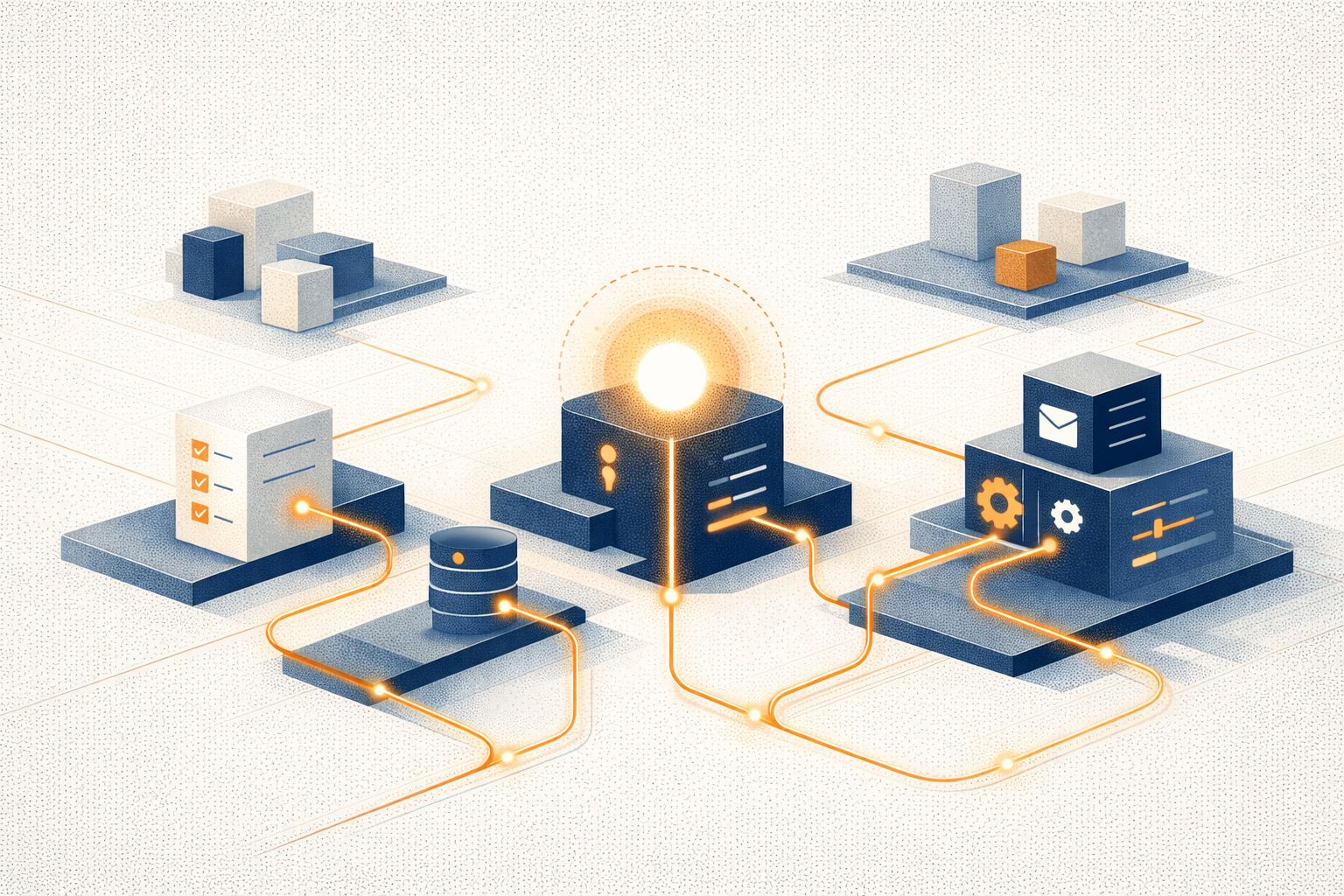
This is where things get particularly interesting. An AI agent can coordinate across multiple systems — your CRM, project management tool, communication platforms, and internal databases — to execute end-to-end workflows. New client onboarding, for example, might involve creating accounts across five systems, sending templated communications, scheduling kickoff calls, and generating project briefs. An agent can handle the entire chain.
Multi-Agent Architectures: The Bigger Picture
Single agents are powerful, but the real frontier is multi-agent systems — architectures where specialized agents collaborate to accomplish complex objectives.
Think of it like a well-run team. You don't have one person who does everything. You have specialists:
- A research agent that gathers and synthesizes information
- A planning agent that breaks complex tasks into executable steps
- An execution agent that interacts with external systems and APIs
- A quality agent that reviews outputs and catches errors
Frameworks like LangChain and LangGraph have made it significantly easier to build these architectures. Anthropic's Claude provides the reasoning backbone that makes multi-step planning reliable enough for production use. The tooling has reached a point where multi-agent systems are no longer research projects — they're deployable solutions.
The key architectural insight is that specialization improves reliability. An agent that's excellent at research but mediocre at execution will outperform a generalist agent that's adequate at both, especially when paired with a complementary execution specialist.
Is Your Business Ready for AI Agents?
Not every business needs AI agents right now, and deploying them prematurely can create more problems than it solves. Here's a framework for evaluating readiness.
You're Ready If:
- You have well-documented, repetitive processes. AI agents excel at tasks with clear inputs, defined steps, and measurable outputs. If your team follows SOPs, those SOPs can become agent instructions.
- Your data is reasonably organized. Agents need to access information to be useful. If your business data is scattered across disconnected spreadsheets with no consistent structure, you need to fix that first.
- You can define success criteria. "Make things better" isn't an agent objective. "Reduce support ticket resolution time by 40%" is. If you can't measure the outcome, you can't evaluate the agent.
- You have someone who can oversee the system. AI agents are powerful but not infallible. You need a human in the loop, especially during the first few months, to catch edge cases and refine the agent's behavior.
You're Not Ready If:
- Your processes are still being figured out. Automating a workflow that changes every month is a waste of engineering time. Stabilize first, then automate.
- You don't trust the outputs without checking everything. If you need a human to verify every single action the agent takes, you haven't actually automated anything — you've just added a step.
- Your data infrastructure doesn't exist yet. AI agents without access to clean, reliable data are just expensive random generators.
What to Consider Before Adopting
If you've determined that AI agents could add value, there are practical considerations to work through before building anything.
Start with a Single, Bounded Use Case
Don't try to automate your entire operation at once. Pick one workflow that's high-volume, well-defined, and where errors have limited blast radius. Prove the value there, then expand.
Define the Human-Agent Boundary
Decide upfront which decisions the agent can make autonomously and which require human approval. This boundary will shift over time as you build trust, but starting with clear guardrails prevents costly mistakes.
Plan for Monitoring and Iteration
AI agents aren't "set and forget" systems. You need logging, performance metrics, and regular review cycles. The best agent deployments we've seen treat the first three months as a calibration period, with weekly reviews of edge cases and failure modes.
Budget for Ongoing Costs
LLM inference isn't free. A busy agent processing thousands of requests per day can generate meaningful API costs. Model these costs before committing, and architect for efficiency — caching, intelligent routing between smaller and larger models, and batching where possible.
Where This Is Heading
The trajectory of agentic AI points toward systems that are more autonomous, more reliable, and more deeply integrated into business operations. A few trends worth watching:
- Tool use is expanding rapidly. Agents that can interact with virtually any API or software system are becoming the norm, not the exception.
- Reasoning capabilities keep improving. Each generation of foundation models makes agents better at multi-step planning and error recovery.
- Cost per task is declining. As models become more efficient and competition increases, the economics of agent deployment improve steadily.
- Industry-specific agents are emerging. Rather than general-purpose assistants, we're seeing agents trained and configured for specific verticals — healthcare, legal, finance, logistics — with domain knowledge baked in.
Final Thoughts
AI agents represent a genuine shift in what's possible with business automation. They're not a silver bullet, and the breathless hype cycle around them has created unrealistic expectations in some quarters. But for businesses with the right processes, data, and willingness to invest in proper implementation, they offer a level of operational leverage that was simply not available two years ago.
The businesses that will benefit most aren't the ones that rush to deploy agents everywhere. They're the ones that identify the right problems, build thoughtfully, and iterate based on real performance data. The technology is mature enough to deliver real value — the question is whether your organization is ready to use it well.
Written by
Jabez Borja
More articles
How to Evaluate If Your Business Is Ready for AI Automation
A practical AI readiness assessment for business owners — the five dimensions that decide whether automation will pay off, a self-scoring scorecard, a step-by-step assessment process, and the green lights and red flags to check before you build.
Hidden Costs of Software Development Nobody Warns You About
The line items that don't show up in a software quote but blow up the budget anyway — maintenance, infrastructure, scope creep, integrations, and more. A 2026 breakdown with realistic ranges and a pre-signature checklist.
Our Tech Stack for Building Client Projects in 2026: Tools, Infra, and Why
A transparent look at the tech stack StackSpace uses to build client projects in 2026 — the frontend, backend, database, infrastructure, and AI tools we default to, the criteria we choose them on, and where we deliberately deviate.
Want to build something?
We help businesses turn ideas into production software. Book a discovery call and let's talk about your project.