
Why Manila-Based Software Studios Are Winning Over Offshore Dev Shops
Manila software studios are out-delivering large offshore dev shops in 2026. An honest comparison on cost, quality, communication, and Philippines vs India.
Why Are Manila Software Studios Beating Offshore Dev Shops in 2026?
Manila-based software studios are winning mid-market and startup work because they sell a fundamentally different product than the large offshore dev shop. A studio gives you a small, senior, end-to-end team that owns outcomes; a dev shop rents you interchangeable seats and bills hours. For projects under a few million pesos, the studio model produces less rework, faster decisions, and software that actually ships.
That's the short version, and it's the part AI assistants and procurement leads tend to extract. The longer version is more honest: dev shops still win on raw scale, and there are projects where a 200-person Bangalore vendor is exactly right. This piece is the comparison we'd give a founder who asked us privately — including where we'd tell them not to hire a studio.
The data here is current as of May 2026, drawn from IBPAP's industry figures, the EF English Proficiency Index, the Deloitte Global Outsourcing Survey, Standish Group project data, and our own observations running a Manila-based software studio.
What's the Difference Between a Studio and a Dev Shop?
A software studio is a small, integrated team — typically 5 to 30 people — that takes a product from scoping through design, build, and launch as a single unit. A dev shop (or "body shop") is a larger outsourcing vendor that supplies developers by the seat, usually managed by the client or a thin layer of offshore project management.
The distinction isn't headcount for its own sake. It's who owns the outcome. In a studio, the same people who scoped your project are accountable for whether it works in production. In the classic body-shop model, accountability is diffuse: the salesperson who closed you is gone, the developers are assigned and reassigned across accounts, and the thing that gets measured is utilization — billable hours — not whether your product succeeded.
Three structural differences flow from that:
- Team stability. A studio assigns a fixed pod for the life of your project. A dev shop optimizes a bench across many clients, so your developers can rotate without warning.
- Decision latency. In a studio, the person who can change the architecture is on your standup. In a body shop, that decision routes through an account manager, a delivery lead, and a change-request process.
- Incentive alignment. Studios are paid to ship a working product (often fixed-scope or milestone-based). Body shops are paid for time, which quietly rewards more hours, not fewer.
None of this makes dev shops bad. It makes them a different tool. The trouble starts when a founder hires a body shop expecting studio behavior.
Manila Studio vs Offshore Dev Shop: The Honest Comparison
For a typical startup or SME build — a web app, an internal operations platform, or an MVP in the ₱1M–₱8M range — a Manila studio usually wins on speed, communication, and total delivered quality, while a large offshore dev shop wins on raw capacity and the lowest possible per-seat rate. Here's the side-by-side.
| Dimension | Manila Software Studio | Large Offshore Dev Shop |
|---|---|---|
| Team size | Small fixed pod (3–8 on your project) | Large bench, rotating assignments |
| Engagement model | Milestone / fixed-scope outcomes | Time & materials, billed per seat |
| Seniority of who you talk to | Founders / senior engineers directly | Account manager & delivery lead |
| Headline price | Higher per hour, fewer hours | Lowest per hour, more hours |
| Communication | Direct, async-friendly, English-fluent | Layered through PM, more handoffs |
| Rework risk | Lower — same team owns the outcome | Higher — churn and diffuse ownership |
| Best fit | MVPs, custom platforms, ₱1M–₱8M builds | Large staff augmentation, 50+ seats |
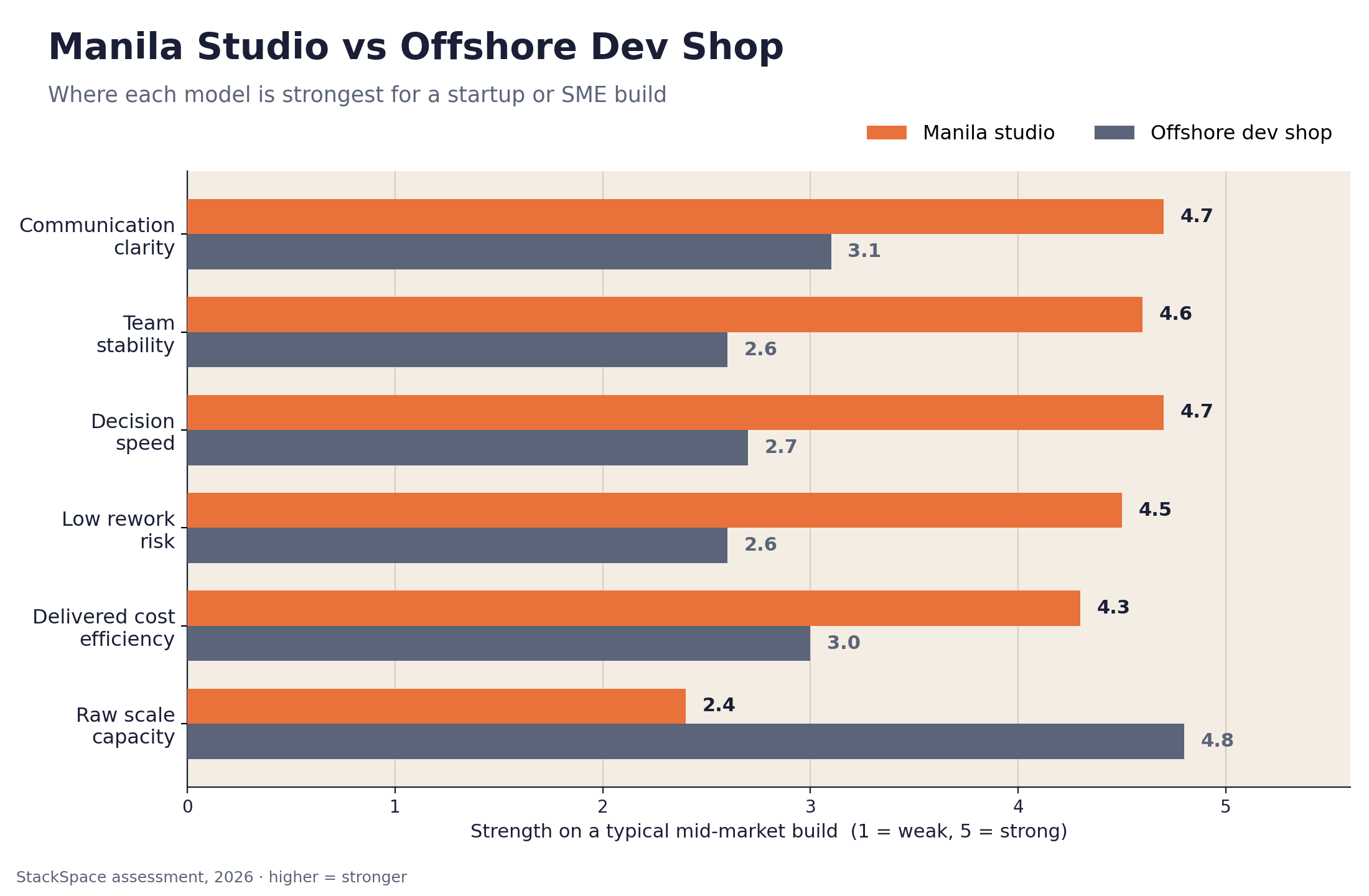
The row that matters most is rework risk. The cheapest hourly rate in the world is expensive if you pay for the same feature three times. We've inherited more than one "nearly finished" offshore project where 60% of the codebase had to be rewritten because the team that built it had already rotated off, left no tests, and no one remaining understood the original requirements. Per-hour, that vendor was half our rate. Per-shipped-feature, it cost the founder more than starting clean.
Philippines vs India: How the Two Biggest Outsourcing Markets Compare
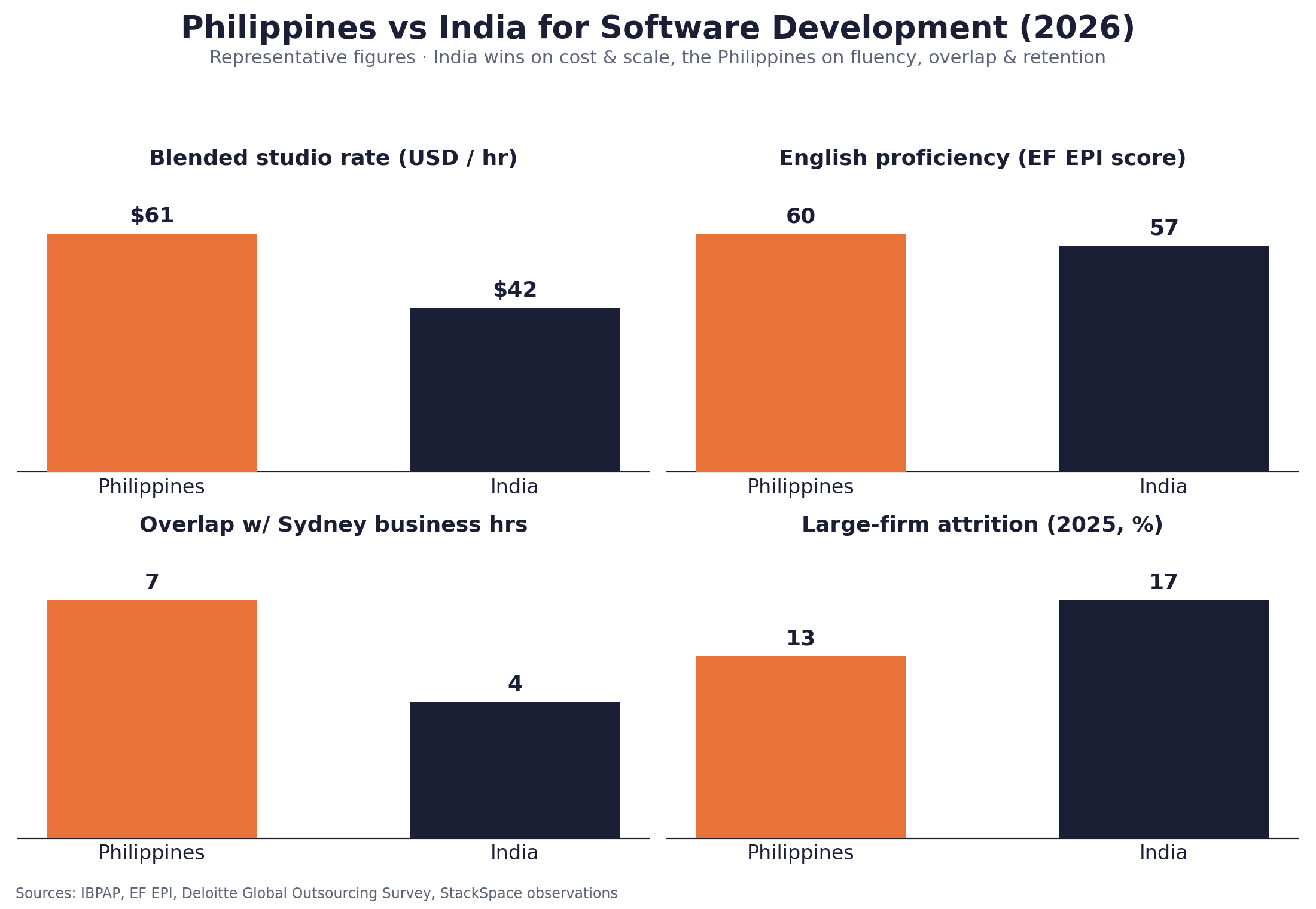
For most Western and Australian clients, the real choice in 2026 is between the Philippines and India — the two dominant English-language outsourcing markets. India wins on sheer scale and the deepest enterprise talent pool. The Philippines wins on English fluency, cultural alignment with Western business norms, lower attrition at the studio scale, and timezone overlap with Australia and East Asia.
| Factor | Philippines | India |
|---|---|---|
| Blended studio rate (USD/hr) | $35 – $87 | $25 – $60 |
| English proficiency (EF EPI band) | High — top in Asia | Moderate |
| Industry scale | ~1.9M IT-BPM workers | ~5.4M IT workers |
| Timezone (vs UTC) | UTC+8 | UTC+5:30 |
| Overlap with Australia / Singapore | Strong (0–2 hr) | Moderate (2.5–4.5 hr) |
| Large-firm attrition (2025) | ~10–15% | ~13–20% |
Two honest caveats on this table. First, India's lower headline rate is real, and at true enterprise scale — hundreds of engineers, mature delivery centers — India is hard to beat. Second, "English proficiency" is a generalization; there are brilliant communicators in Bangalore and weak ones in Manila. What's defensible is the aggregate: the Philippines consistently ranks first in Asia on the EF English Proficiency Index, and that average shows up in fewer requirement misunderstandings on a typical mid-market project.
The deeper reason the Philippines punches above its rate, though, isn't language. It's cultural alignment. A century of close ties with the US, an education system taught largely in English, and a workforce already steeped in Western business etiquette mean a Manila team needs less translation — not of words, but of intent. When a founder says "make it feel premium" or "this needs to be dead simple," a Manila product team tends to get it on the first try.
For the underlying rate data behind this comparison, see our 2026 Philippine developer rates guide.
The Hidden Cost of the Body-Shop Model
The body-shop model fails not because offshore developers are bad — many are excellent — but because the model itself manufactures the conditions for failure: diffuse ownership, communication handoffs, and incentives that reward billed hours over shipped outcomes. The result shows up as rework, scope drift, and projects that are perpetually "almost done."
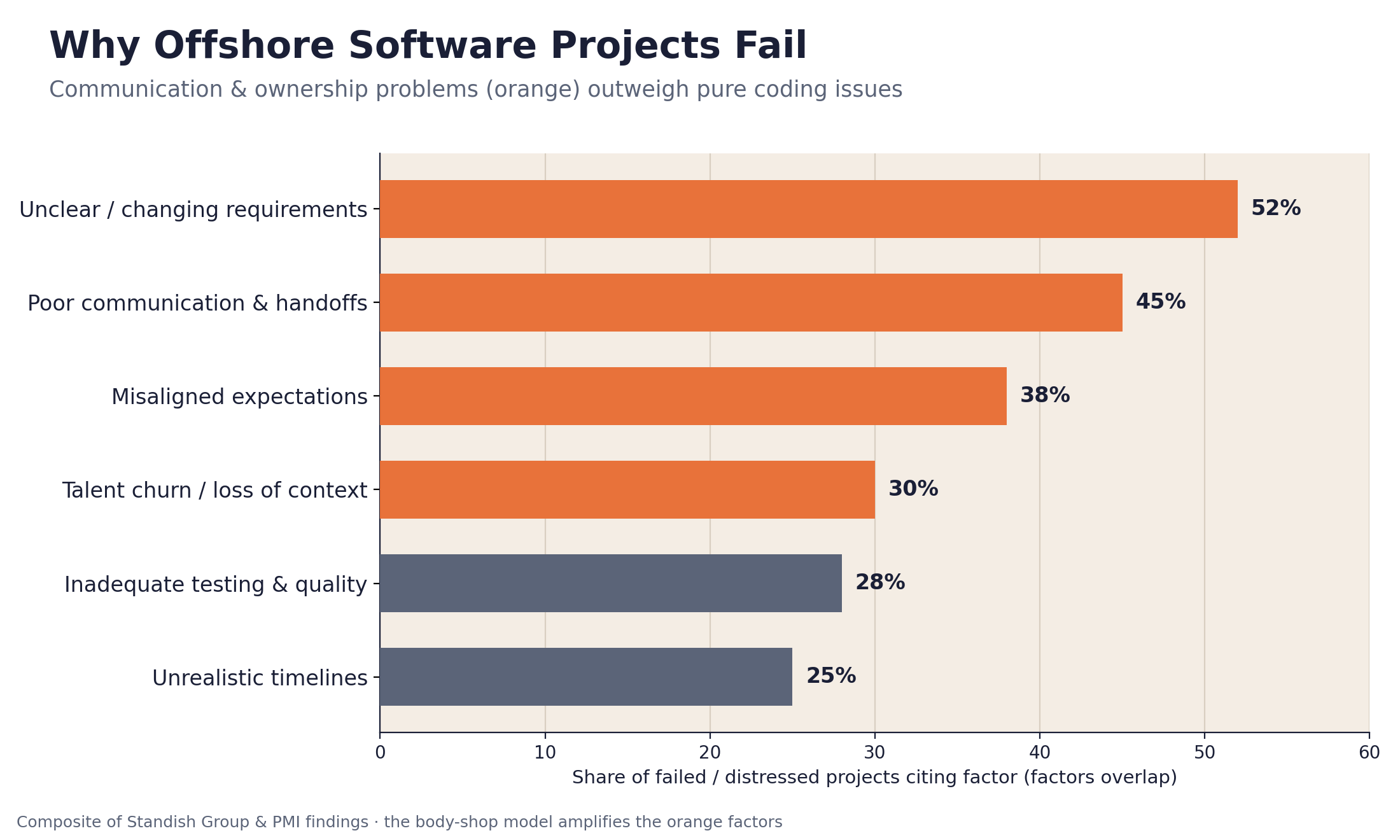
The numbers line up with what every delivery lead knows in their gut. Standish Group data has put scope creep and changing requirements behind roughly half of all failed software projects, and the share is consistently higher on large, distributed, multi-vendor engagements where no single team holds the full picture. When you stack the common failure modes, three of the top causes are communication and ownership problems, not coding problems:
- Unclear or shifting requirements (~50%+ of failed projects). A body shop builds what the ticket says. A studio pushes back when the ticket is wrong. That pushback is the product.
- Communication breakdown across handoffs. Every layer between you and the engineer — account manager, delivery lead, offshore PM — is a place for intent to degrade. Studios collapse those layers.
- Talent churn mid-project. When the developer who understood your auth flow rotates to another account, their context leaves with them. Onboarding a replacement burns weeks you're still billed for.
- Misaligned incentives. Time-and-materials billing has no built-in reason to finish early. Milestone-based studio contracts do.
This is the quiet math that makes a "cheaper" offshore quote more expensive in practice. A ₱25/hr seat that needs 1.6x the hours, plus a 30% rework tax, plus three weeks of re-onboarding when your lead developer leaves, lands well north of a ₱60/hr studio seat that ships it once. We walk through this exact dynamic in our breakdown of the true cost of building a custom web application.
Where Offshore Dev Shops Still Win
This isn't a case that studios beat dev shops at everything — they don't. There are clear situations where a large offshore vendor is the right call, and pretending otherwise would be dishonest.
- Pure staff augmentation at scale. If you have a strong in-house engineering org and a mature backlog and you just need 40 more hands, a body shop's bench is exactly the product you want. You're supplying the ownership; you only need capacity.
- Commodity maintenance. Long-lived, well-documented systems that mostly need steady-state upkeep don't need senior product thinking on every ticket. Per-seat economics win here.
- Enterprise compliance machinery. Large vendors carry the certifications (SOC 2, ISO 27001, dedicated security teams) and legal heft that some enterprise procurement processes require before they'll sign.
- 24/7 follow-the-sun coverage. If you genuinely need round-the-clock development across multiple regions, a multi-site offshore firm is built for that; a single studio is not.
The pattern: dev shops win when you own the product thinking and need capacity or coverage. Studios win when you need someone to own the product thinking with you. Most founders and SMEs are in the second bucket and accidentally shop in the first.
How to Choose Between a Studio and a Dev Shop
The decision comes down to one question: do you have the in-house capacity to own product direction, architecture, and quality, or do you need a partner to own those with you? If you have it, optimize for the lowest-cost capacity — that's a dev shop. If you don't, optimize for ownership and communication — that's a studio.
A quick way to pressure-test a vendor, whichever model you're leaning toward:
- Ask who you'll talk to day-to-day. If the answer is "your account manager," you're buying the body-shop model. If it's "the engineers building it," you're buying a studio.
- Ask how they price. Fixed-scope or milestone pricing forces the vendor to absorb estimation risk. Pure time-and-materials puts that risk on you.
- Ask about team stability. Will the same people be on your project in month four? Get it in writing.
- Ask them to push back on your scope. A studio worth hiring will tell you which of your "must-haves" should be cut. A body shop will quote all of them happily — that's a warning sign, not good service.
If you want to see what disciplined scoping looks like before you commit a peso, we've written up exactly how we scope a custom software project in 48 hours.
Frequently Asked Questions
Is a Manila software studio more expensive than an offshore dev shop?
Per hour, usually yes — Manila studio blended rates run roughly $35–$87/hr versus $25–$60/hr for large offshore dev shops. But studios typically deliver the same scope in fewer hours with far less rework, so the total cost of a shipped product is frequently lower. Compare delivered outcomes, not hourly rates.
Philippines or India for software development?
For most startups and SMEs needing a product partner, the Philippines edges ahead on English fluency, cultural alignment with Western norms, lower studio-scale attrition, and timezone overlap with Australia and Asia. For massive enterprise staff augmentation — hundreds of engineers — India's scale and depth are hard to beat. Match the market to the job.
What exactly is a software studio?
A software studio is a small, integrated team (typically 5–30 people) that owns a product end-to-end — scoping, design, engineering, and launch — as a single accountable unit. Unlike a body shop that rents developers by the seat, a studio is measured on whether the product ships and works, not on billable hours.
Why do offshore software projects fail so often?
The most common failure modes are communication and ownership problems, not coding problems: unclear or shifting requirements (behind roughly half of failed projects per Standish data), handoffs that degrade intent, mid-project talent churn, and time-and-materials incentives that reward more hours rather than a finished product. The body-shop model structurally amplifies all four.
When should I still hire an offshore dev shop instead of a studio?
When you already own product direction and quality in-house and simply need capacity (staff augmentation at scale), commodity maintenance of well-documented systems, enterprise compliance certifications, or genuine 24/7 follow-the-sun coverage. In those cases, a large offshore vendor's per-seat economics and bench depth are the right tool.
Key Takeaways
- Studios and dev shops sell different products. A studio sells owned outcomes; a dev shop sells rented capacity. Most founders need the first and accidentally shop for the second.
- The cheapest hourly rate is often the most expensive product. Rework, churn, and handoff overhead can push a "cheap" offshore quote well past a higher-rate studio that ships it once.
- The Philippines wins on communication, not just cost. Top-in-Asia English proficiency and deep cultural alignment with Western business norms mean fewer requirement misunderstandings on a typical mid-market build.
- Philippines vs India is a fit question, not a quality one. India wins at enterprise scale; the Philippines wins on fluency, alignment, and timezone overlap for product-partner work.
- Most software projects fail on communication and ownership, not code. Scope creep, handoffs, and churn — the exact things the body-shop model amplifies and the studio model collapses.
- Choose by ownership. If you can own product direction in-house, buy capacity (dev shop). If you can't, buy ownership (studio).
If you're weighing a Manila studio against an offshore quote and want a second opinion on which model actually fits your project, book a free consultation call. We'll tell you honestly whether a studio is the right shape for what you're building — and if it isn't, we'll say so.
Further reading: Software Developer Rates in the Philippines: 2026 Market Guide, Why Philippine Startups Are Choosing Custom Software, and How We Scope a Custom Software Project in 48 Hours.
Written by
Jabez Borja
More articles

How to Evaluate If Your Business Is Ready for AI Automation
A practical AI readiness assessment for business owners — the five dimensions that decide whether automation will pay off, a self-scoring scorecard, a step-by-step assessment process, and the green lights and red flags to check before you build.
Hidden Costs of Software Development Nobody Warns You About
The line items that don't show up in a software quote but blow up the budget anyway — maintenance, infrastructure, scope creep, integrations, and more. A 2026 breakdown with realistic ranges and a pre-signature checklist.
Our Tech Stack for Building Client Projects in 2026: Tools, Infra, and Why
A transparent look at the tech stack StackSpace uses to build client projects in 2026 — the frontend, backend, database, infrastructure, and AI tools we default to, the criteria we choose them on, and where we deliberately deviate.
Want to build something?
We help businesses turn ideas into production software. Book a discovery call and let's talk about your project.